
Sauntering around the Fair Oaks Horticulture Center last Saturday on an Open Garden Day, I was amazed at the number of cucumber questions being thrown at me. And that makes sense. Even though my garden world tends to revolve around tomatoes and peppers, I keep forgetting about that National Gardening Association national poll of gardeners that revealed that the Number 2 Most Popular Vegetable for the Backyard Garden is cucumbers. (Tomatoes were Number 1, naturally).
So, I thought it was time for a quick crash course from our favorite retired college horticultural professor, Debbie Flower (an avowed cucumber head), about how to select, plant and grow cucumbers. You can hear what she had to say in today’s podcast (with a transcript below, naturally).
For Cucumber Success…
For cucumber success, Debbie says freshness, warmth and water are at the top of the list.
“The soil needs to be moist, not wet, but moist, all the time,” explains Flower. “Cucumbers are a warm season plant, a warm season annual. They need soil temperatures to be quite warm when you seed them. And you typically want to direct seed them, not start them from transplants ahead of time. They get root bound while in a container, it dwarfs them. They will never grow very big. If you do that once in your gardening life, you’ll remember it. It’s such a disappointment.
“I just tried my second time planting my cucumber seeds. I had planted some old seeds a few weeks ago and that might have been my problem. In general, you don’t want to keep cucumber seeds more than two years. And these were two-year-old seeds. Even though I stored them correctly, in the refrigerator over those two years, they just didn’t germinate. So yesterday I planted fresh seed. I would advise starting with fresh seed, plant them directly into the garden when your night temperatures have settled at 50 to 55 degrees Fahrenheit or greater. They need six to eight hours of sun, that’s considered full sun. They need well drained, fertile soil and regular moisture.”
The National Gardening Association offers these cucumber growing tips:
“Like tomatoes, cukes are warmth lovers so wait until the soil is warm and frost danger past before sowing seeds. If you garden in a short season part of the country, you can get a head start by starting seeds indoors in individual biodegradable pots no more than 3-4 weeks before you plan to set them out. But because they are fussy about transplanting, plants from direct-sown seeds often catch up with transplants, so an early start doesn’t gain you a great deal.
What’s key for a good crop of cucumbers? A good support system for vines, protection from cucumber beetles that feed on young plants and can transmit deadly bacterial wilt disease, and consistent soil moisture -- cukes are mostly water after all! Misshapen, bitter fruits are the result of water stress. Drip irrigation combined with mulch will help you harvest top quality fruits.”
Concerned about bitterness in cucumbers? Select the newer hybrid varieties, which have been bred to reduce the cause of the bitterness. That’s according to Dennis Pettinger, longtime UC Cooperative Extension Environmental Horticulturist. He adds, “If the cucumbers express bitterness, it can usually be eliminated by peeling away the skin and outer flesh and removing the stem end.”
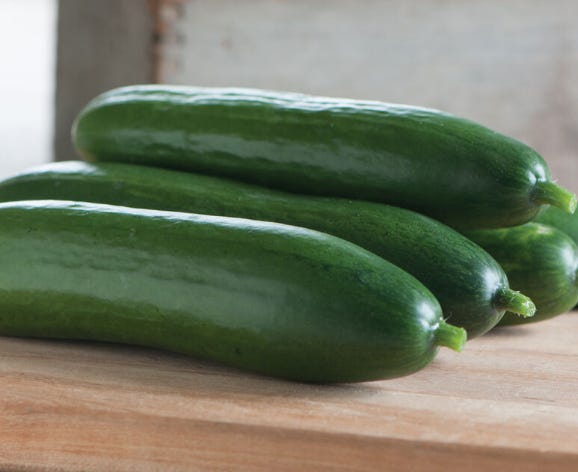
There are newer cucumber varieties that have been bred to be less bitter. Among them:
Diva: A popular, mild, and crisp slicing cucumber that is bitter-free and mildew-resistant, ideal for snacking.
Persian (Green Finger): Small, thin-skinned, and very crisp, these are productive on vines and should be harvested at 3–5 inches.
Lemon: Round, pale yellow, and sweet. They are known for lacking the bitter compounds found in other varieties, though they are late to bear.
Marketmore Select: A reliable slicing variety with improved disease resistance and straight, dark green fruit (noted in regional trials).
Sweet Success: Known for its bitter-free quality and high productivity, often recommended by local Master Gardeners.
Armenian: Highly heat-tolerant and technically a melon, this variety produces long, crunchy, light-green, striped fruits, making it excellent for hot, dry areas.
The Contra Costa County Master Gardners have recommendations for cucumbers that can be grown in large containers:
“Some favorite cucumber varieties for container gardening are Diva, Japanese Climbing, Persian, and Unagi. All ripen in 55–60 days and continue producing cukes until colder weather sets in. The fruit should be harvested before it grows more than 9–10 inches long. Diva produces tender, crisp, and bitter-free fruit to about 7 inches and is mildew-resistant if grown in cooler locales. Japanese Climbing cukes bear 9-inch tender, crisp, slightly tart fruit and are excellent trellis climbers. Persian “Green Fingers” should be picked when about 5 inches long, and provide thin-skinned, crisp fruit on mildew-resistant vines in hard-to-grow conditions. Unagi provides glossy, crisp, and tasty fruit in high yields of up to 10 inches, and vines are disease-resistant.”

Cucumbers 101: The Podcast Transcript
Farmer Fred:
[0:00] It came as a surprise to me when I discovered that one of the most popular episode we played last year was one about growing cucumbers. Now, my wife and I are not that fond of cucumbers. We kind of like leave it to those who do like cucumbers. Well, you know who likes cucumbers. That same person who talked to us last year about growing cucumbers is back. And that would be America’s favorite retired college horticultural professor, Debbie Flower, right here, old cucumber breath.
Debbie Flower:
[0:31] Yeah, that’s me.
Farmer Fred:
[0:33] Right. With more advice on growing cucumbers, including starting and training cucumbers. And I’m wondering, based on conversations we’ve had in the past, whether it’s better to buy the varieties already started in pots at nurseries or start them from seed.
Debbie Flower:
[0:53] Oh, I’m a big, direct seeder. Start them from seed right where you want them to grow. Let those roots... get established in the soil where they’re going to live. They don’t seem to do well being transplanted. And if they’re too old, too big in the pot, they’ll never form flower and fruit. And it’s so cheap to buy a packet of seeds that you can get the cucumbers you need for this year, store it and get some more next year for like three or four bucks. So I’m definitely one for starting them directly from seed. The thing to be aware of is they need very warm soil to grow from seed. If you put them out and the soil is too cold, below 50 degrees, then they’ll rot. And you’ll go to dig to see what’s going on with my seed. There’s nothing there because it’s been consumed by microorganisms in the soil. So you definitely need to wait for the soil to be a minimum of 50 degrees Fahrenheit.
Farmer Fred:
[1:45] And it depends what part of the yard it might be in, the nature of that soil. Is it usually wet? Is it usually dry? And nighttime temperatures play a part too. And that might be one of the better barometers for determining soil temperature. You don’t have a soil thermometer is wait until the nights are steadily over 50 degrees. Right.
Debbie Flower:
[2:05] That’s an excellent way to tell what the average soil temperature is where you live, is to look at lowest temperature at night. And that will reflect or is because the soil is that temperature. So I totally support starting them from seed. Know where you’re going to grow them. They need full sun. So you have to have a place to have full sun and well-drained soil. No puddling there. And some organic matter in the soil. You can grow them in clay. You can grow a lot of things in clay, but you better have, or at least mulch with, organic material. And over time, that organic material will become incorporated into the clay and you’ll have improved soil. Watering clay soil correctly is a whole other story. So just be aware that you’re going to have to pay attention to that.
Farmer Fred:
[2:48] Whenever I’m thinking of this family, the Cucurbit family, I think about planting squash seeds or pumpkin seeds. And usually the advice on planting those seeds is to plant them on a mound in very rich soil, usually manure-addressed soil, or some sort of really just nice, nice stuff, but raised for better drainage. Is that true with cucumbers?
Debbie Flower:
[3:15] It can be. Depends on your soil. If you have really nice, well-draining soil, sandy soil. I was surprised when I was doing some gardening work at my son’s house in Minnesota. He lived, he had sandy soil. If you live near a body of water, you’ll probably have sandy soil. So if you have sandy soil that drains well, then it’s warm enough so you don’t have the puddling of water that can be a problem with cucumbers. In that case, you’re probably going to have a lack of nutrients. And so that’s where the manure would come in. Composted chicken manure is an excellent thing to add to soil to add some nutrition that is needed by these kinds of plants. They’re pretty fast growers, so you need to keep that nutrition going. So not just amend the soil once and let them grow, but come back and add things like mulch that’s made of some high nutrient stuff like freshly made hot compost or more chicken manure and fertilizing with preferably low analysis organic fertilizers like fish emulsion.
Debbie Flower:
[4:22] Low analysis means that the three numbers on the front of the container, which tell you the amount of nitrogen, phosphorus, and potassium are very low. Definitely not double digit, but single digit. If you have some of that fertilizer that has a high analysis, 16, 16, 16, or 10, 10, 10, you can dilute it more than, meaning put on less than the label says, so that you’re not shocking the plant into growing too fast. Plants like that in that family that grow really fast will become infested with sucking insects like aphids, because they put on so much vegetation very quickly, they don’t, When a leaf first comes out of the bud, it isn’t protected with the waxy coating that it will ultimately get. And so if the plant is constantly putting on new leaves, the waxy coating takes more time to come along. That’s the protection from those insects. And so all of a sudden, you’re going to have a tremendous population of sucking insects. Yes, fertilize, but not too much all at once.
Farmer Fred:
[5:22] Do you trellis your cucumbers?
Debbie Flower:
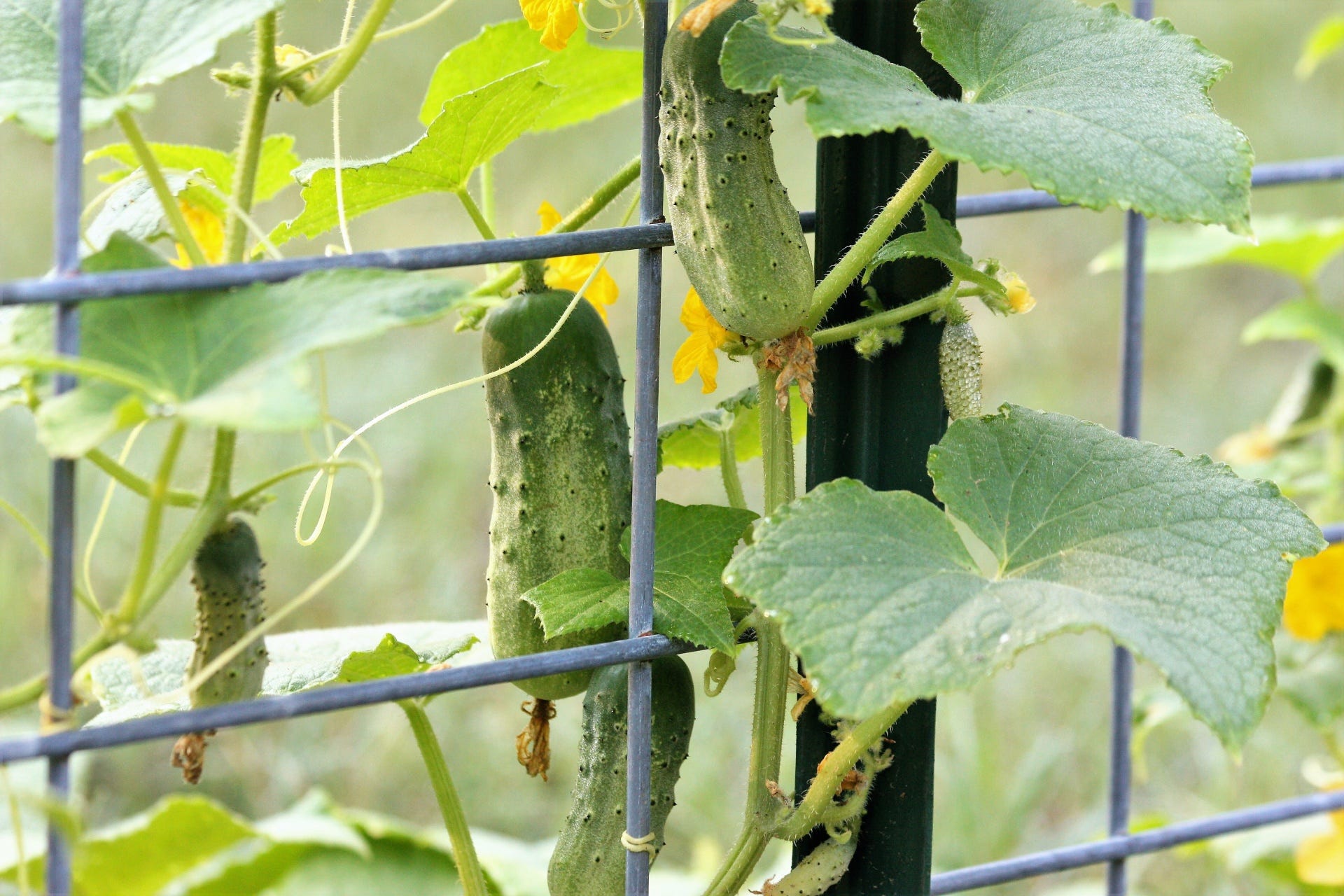
[5:24] I do. I want to keep them off the ground. They can rot pretty easily if they’re touching the ground. I don’t mulch with plastic. If you’re into mulching with plastic, then that will help somewhat. However, if there’s water on top of the plastic, it’s not going to solve that problem. You’re going to have puddles that the fruit is potentially sitting in. Also, I think it’s easier to harvest and it’s easier to see them. So the cattle panel curved into a circle makes a great trellis for many things, cucumbers included, because it’s got a four inch by four inch openings in it. You can get your hand in there and reach the fruit. When you harvest a cucumber, you want to cut the fruit off of the vine, not twist it off. Twisting can wreck the plant.
Farmer Fred:
[6:09] All right. That’s important to remember is to clip them off.
Debbie Flower:
[6:13] And there are bush cucumbers. If you only have a small amount of space or are doing container gardening, let’s say in wine barrels, then you would want a smaller plant so it doesn’t become root bound in that container. And bush cucumbers, you don’t need to trellis. You can, you can put a trellis around them. I have cats in my neighborhood and I tend to put some sort of structure around a lot of plants so that the cats don’t make them their own, let’s say. So you’re going to give, you have to give, the plants space. They get to be quite large. Look at the seed packet. It’s going to tell you what kind of spacing. Three feet by four feet, I think is a good spacing for cucumbers. Seed packets often say, plant one every two inches in rows that are three feet apart, and then come back and pull out a whole bunch of other ones.
Farmer Fred:
[7:04] That seems cruel.
Debbie Flower:
[7:05] I agree. I don’t like that method.
Farmer Fred:
[7:07] Let’s talk about that because that’s a good point. Pulling out as opposed to clipping.
Debbie Flower:
[7:13] Oh, yeah. It shouldn’t be pulled out.
Farmer Fred:
[7:14] Yeah. If you’re pulling it out, you’re disturbing roots of the other plants.
Debbie Flower:
[7:17] The roots are going to grow among each other. So if you do have to thin, you want to do it with a scissor. Cut off the ones you don’t want. If I have fresh seed in a new packet, by law, it has to have about a 90% germination or it has to say on the packet what the germination is. So I expect all those seeds to germinate. If I want to do the circle, as you mentioned, on a high spot... that’s fine. I don’t do that. I line my cucumbers up and put the trellis behind them. Or I do them separately and trellis each individual plants.
Farmer Fred:
[7:49] But you could do both.
Debbie Flower:
[7:50] You could do both, right. You have some freedom in how you want to do that. But they need space. If you’re doing it on a circle, that circle needs to be probably three feet across. It doesn’t have to be real high, maybe six inches at the most, but it has to be wide so that the plants can spread out.
Farmer Fred:
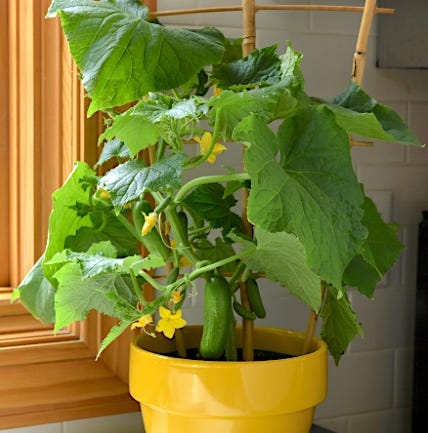
[8:05] We were talking awhile back with Diane Blazek of the National Garden Bureau, and they had just awarded their Green Thumb Award plants for 2024. And one was a cucumber house plant called Quick Snack Cucumber. It gets 15 to 20 inches wide and 20 to 24 inches tall. And you could grow it indoors, have to be a real sunny window, I would think. But basically, they’re pushing it as not only something you can eat, but something you could use as a houseplant.
Debbie Flower:
[8:37] That’s pretty amazing. Yes. And so, something that comes to mind when I’m talking about growing inside is how does the fruit get pollinated? And what I’m seeing in this description is it’s something called a parthenocarpic variety.
Debbie Flower:
[8:54] Parthenocarpic is a plant that sets fruit without having a pollinator visit it. Think of navel oranges. We’re here, we live in orange country here in California, and navel oranges have no seeds in them. And that’s because they’re not visited by pollinators. The plant basically has a false pregnancy. It produces a baby without having mated with anybody. And so there are plants that will do that. And this Parthenocarpic Quick Snack cucumber is one of those. For those of us who grow regular cucumbers in the garden, we do need to think about pollination. The cucumber will have male flowers first. They’re big yellow sort of trumpet-shaped flowers, and the pollen is ripe in the morning, but it’ll take a while, a week or two before it starts, or longer, depending on the culture of the plant, before it starts producing female flowers. So when it starts to flower, go out and look at that flower. It’ll be a yellow flower with a finger sticking up in the middle, and it’s on that finger that the pollen forms. Now you know what a male flower looks like. Keep checking. You’ll get a female flower eventually. It’ll be the same yellow trumpet flower. But when you look inside, it’s more like a, I think of it as a brain.
Farmer Fred:
[10:08] Not sexist at all.
Debbie Flower:
[10:09] Go ahead. Not because, just because of what it looks like. It’s like, anyway, it’s not the finger. It’s like a more flat-topped structure.
Farmer Fred:
[10:18] Looks more like somebody who thinks with a brain, not with a stem.
Debbie Flower:
[10:23] Well, nature only has so many shapes. So then, and it’s a morning job, I like to go out and find a male flower that’s also opened on the same day and take it off, break it off the vine, peel off the petals and go over to the female flower and touch that central finger to the flat surface inside the female flower to transfer the pollen. If you have a very floriferous garden, meaning other things around that are in bloom that are attracting pollinators like bees, you may not have to do the pollination yourself. It is something that bees will do. But if you don’t have a lot of bees around in your garden, then you will want to go out and do that yourself.
Farmer Fred:
[11:05] So might young cucumber plants have the same malady that young squash plants have, that there is incomplete pollination because of that, because of squash plants. Again, you got the male flowers and then come along the female flowers and they both have to be in sync and the temperatures have to be right for full pollination to happen. But in case of partial pollination, you end up with a fruit that doesn’t get very long and kind of shrivels up and dies.
Debbie Flower:
[11:33] I don’t think I’ve ever seen that due to lack of pollination. I imagine it could occur. But I know I have seen it due to irregular watering. It gets what is called blossom end rot in tomatoes, where it doesn’t fully form. And watering is very critical with cucumbers. They have fairly shallow roots. They need very even watering, but well-dressed. need to be in well-drained media. And so, you want to mulch their root zone.
Debbie Flower:
[12:01] And it’s going to be wide. It’s going to be wider than the plant. Don’t get the mulch up against the stem, but have it spread out wide on all sides so that the soil does not dry out quickly.
Farmer Fred:
[12:11] All right. So, you’re talking cucumbers specifically. Yes. As opposed to the problems squash might have, even though they’re in the same family.
Debbie Flower:
[12:18] Yes. Okay. I have not seen it. I imagine it does occur, but I have never seen it on a cucumber.
Farmer Fred:
[12:25] It must be the variety you’re growing.
Debbie Flower:
[12:26] I’ve grown different ones, but it could be. Straight A and Chelsea Prize are two that I’ve grown quite frequently. But I’ve grown others as well, and I’ve never had the problem. And you don’t grow them, so I can’t ask you.
Farmer Fred:
[12:39] True. Although I’d be curious to try to grow a Quick Pick in the house.
Debbie Flower:
[12:43] I would too.
Farmer Fred:
[12:44] You don’t get big cucumbers on this plant too, by the way. The fruit, it says here, get about one and a half to two and a half inches long.
Debbie Flower:
[12:53] Oh, so they’re pickling. They’re gourmet cucumbers. Well, they do sell them, you know, you’ve seen them in the grocery store, those packets of cocktail size or pickling size. Yeah. Yeah. If you want to pickle, you want to pick the fruit when it’s pretty small. You get a better pickling done. Although I don’t know if you remember going to the store and getting the big pickle out of the big container?
Farmer Fred:
[13:17] At the general store and sitting around the cracker barrel?
Debbie Flower:
[13:20] It was the meat store my mother would go to. We always had a barrel of pickles. And I was just, I like pickles. So they were dill. And we’d get one and it was huge, but enjoyed eating that. So you can pickle any size you want. But it’s traditional for pickling cucumbers to be picked when they’re between two and six inches long. Whereas slicing are usually bigger than that, seven to ten inches long. If you’re having bitter cucumbers, which can be a problem... The causes of that tend to be irregular watering or temperatures that get very cold. So keep track of that. And you want to cut the fruit off the vine rather than twisting it and then use them immediately or refrigerate without washing. Once you introduce water, then you’re going to rot the cucumber.
Farmer Fred:
[14:09] And I am sure someone will write in this year because they write in every year with the same question about bitter cucumbers. What causes bitterness?
Debbie Flower:
[14:18] You aren’t listening. I just said that.
Farmer Fred:
Oh. Okay. All right.
Debbie Flower:
Irregular watering. And soil temperatures that are too cold. So the latter would have to be happening at the end of the season if suddenly temperatures got cold. Or in parts of the country I haven’t lived where, you know, one day it’s spring, one day it’s summer, and one day it’s winter.
Farmer Fred:
[14:40] Let me rephrase the question. Since you brought up these things that can happen to cause bitterness, I’ve heard it said that if you just scrape off the ends and the skin, it’ll remove a lot of the bitterness.
Debbie Flower:
[14:54] I’ve heard that and I’ve heard and I’ve tried it and sometimes it seems to help and sometimes it doesn’t. And I’ve heard of cutting off the stem ends. So, the end that was attached to the plant and rubbing just like a half inch of the fruit and then rubbing that vigorously with the remaining piece of cucumber and some foam forms and supposedly that brings it out. I don’t know that I believe that.
Farmer Fred:
[15:18] It says here, the University of California, if you want to believe them, we will. They say about cucumbers, large temperature swings and shade can cause bitterness.
Debbie Flower:
[15:28] Okay. That’s where that cold soil can come from.
Farmer Fred:
[15:31] Yeah, and they don’t thrive in very cool, foggy, or windy locations.
Debbie Flower:
[15:35] Right. So, it’s not a coastal crop around here. Right. Yeah.
Farmer Fred:
[15:39] Unless you have a microclimate.
Debbie Flower:
[15:41] Right. So, you have that special one.
Farmer Fred:
[15:44] Or grow it in a greenhouse.
Debbie Flower:
[15:45] Grow it in a greenhouse, yeah.
Farmer Fred:
[15:46] You could do that too. Let’s talk about some cucumber types. You mentioned a few varieties, but they have various uses. I’ve seen brown ones and long ones and vining ones. Hybrids, of course, might solve a lot of problems of cucumbers.
Debbie Flower:
[16:05] Yes, prevent pest problems. Yeah.
Farmer Fred:
[16:07] But you’ve got English and Persian, Armenian and Asian.
Debbie Flower:
[16:11] Yeah, and I’m not well versed on them. The Armenians I grew, I didn’t like at all. To me, they were somewhat dry. I like a nice, crisp, wet cucumber with a thinner skin. So for me, the Chelsea Prize does that. The Chelsea Prize, though, you better watch. It can grow really, really huge fruit. I don’t like the lemon cucumber. There are round ones and they turn yellow. They taste lemony. And that’s, to me, not what a cucumber tastes like. So personally, I don’t like that. But they produce. They’re quite prolific. And I know many people do like them. There are some that are called burpless. And they’re supposed to have less of the compounds in them that cause humans to burp.
Farmer Fred:
[16:48] Yes. What is that compound?
Debbie Flower:
[16:50] I don’t know.
Farmer Fred:
[16:51] Yeah, I’m trying to think, too. It’s not capsaicin.
Debbie Flower:
[16:53] No, that’s...
(FREDNOTE: Cucumber burping is caused by the accumulation of a natural organic compound called curcurbitacin.)
Farmer Fred:
[16:55] Yeah. Yeah. Are snails and slugs a problem with cucumbers?
Debbie Flower:
[16:59] I have not had a problem with them, but the conditions where cucumbers grow are certainly something where slugs and snails would like to be.
Farmer Fred:
[17:07] And that’s another reason for the trellis too.
Debbie Flower:
[17:10] Yes, get them up off the ground, right. I try to, before I plant, I try to bait for slugs and snails so that they’re not there. Because slugs and snails can consume a baby plant pretty darn quickly.
Debbie Flower:
[17:23] So I try to get rid of them before they occur.
Farmer Fred:
[17:26] How do you tell the difference between a cucumber beetle and a ladybug?
Debbie Flower:
[17:30] Well, isn’t a cucumber beetle yellow? Yeah. And striped?
Farmer Fred:
[17:34] Sometimes.
Debbie Flower:
[17:35] And a lady beetle generally is orange with black spots. Generally. They’re not all that way. Yeah, right. But striping is not a lady beetle.
Farmer Fred:
[17:44] Doesn’t the cucumber beetle have a... Long antennae, too?
Debbie Flower:
[17:49] Don’t know. Okay.
Farmer Fred:
[17:51] I only mention that because Jeanne brought one into the house.
Debbie Flower:
[17:54] Uh-oh.
Farmer Fred:
[17:54] And it was actually, it was, two cucumber beetles mating on the back of a chard leaf. And I go, oh, I’m not worried about it. We don’t grow cucumbers.
Debbie Flower:
[18:05] Yes, you’re right. Cucumber beetles are yellow, and they can be striped or spotted, and they do have long antennae, which is lady beetles do not have the long antennae.
Farmer Fred:
[18:14] That’d be the way you tell them apart, because they kind of look alike.
Debbie Flower:
[18:18] Especially the spotted one. Yeah. Yeah.
Farmer Fred:
[18:20] That’s the only trick question I had.
Debbie Flower:
[18:22] Well, I was looking up what causes the burping.
Farmer Fred:
[18:25] However, you can deter beetles with row covers over newly planted cucumbers or seedlings, but you do want to remove the covers to allow bees to reach the vines when the plants start flowering. Right.
Debbie Flower:
[18:38] Cucurbitacin. Cucurbitacin is chemical. Yes, when I was having a procedure in the doctor’s office without sedation, I was talking to the nurse and she asked me about squash beetles. Now, I didn’t have my, horticulture hat on. No, I was doing something else.
Farmer Fred:
[18:56] You were in pain.
Debbie Flower:
[18:56] And I failed to say, use floating row covers. Yes, you have to take them off once they start flowering, or especially every morning, because that’s when the pollen is transferred. It’s a morning job. But the beetles, then you can cover them back up for the afternoon if you’re
into that, doing that amount of work. But the beetles can be prevented from getting to the plant if you completely cover the plant with floating row cover.
Farmer Fred:
[19:19] This reminds me of the time I had heart surgery. Quadruple bypass heart surgery back in 2012.
Debbie Flower:
[19:26] Without anesthesia talking to the nurse.
Farmer Fred:
[19:28] Well, it was worse than that. It was like hours before the surgery. I think it was actually the afternoon.
Debbie Flower:
[19:35] Oh, and you’re nice and calm. Nothing’s happening here. Yeah, right.
Farmer Fred:
[19:39] And then they want to shave your entire body with a dry razor. Oh. I go, okay, all right, I’m here. I have no choice.
Farmer Fred:
[19:45] Well, all of a sudden, there’s a crowd of nurses and doctors around me, and they’re asking garden questions. Well, this is going on. And I’m explaining how to build a raised bed.
Debbie Flower:
[20:00] They probably think they’re distracting you from what’s happening.
Farmer Fred:
[20:03] So I wouldn’t worry about the dry razor. Yeah, that’s like, come on.
Debbie Flower:
[20:08] So keep the weeds down around these cucumbers because they don’t like competition. You don’t want the moisture to be taken away from the roots by the weeds. You don’t want insects, you know, bad guy insects to be trapped in the weeds either. So keep it weed free. A nice little mulch helps with that. And really enjoy.
Farmer Fred:
[20:27] And do the more you pick, will you get more?
Debbie Flower:
[20:29] The general answer is yes. The plant’s goal in life is to make seed. And if you mature seed, we eat them before those seeds are mature. If you wanted to save seed from your cucumber to grow some for the next year, you would have to leave it on the plant beyond the point where you would eat it. It would become dry and chewy. And then you would have seed in there that’s viable, meaning it has life. Every time you take off a cucumber for eating, when it’s much smaller, before those seeds are fully ripe, then the plant hasn’t satisfied its mission
Debbie Flower:
[21:02] in life, which is to make babies that will follow in its footsteps and grow. So it has to make another fruit. Beans are like that. Peas are like that. A lot of things we grow are like that.
Farmer Fred:
[21:13] I guess cucumbers are susceptible to verticillium wilt. So I would imagine in the world of hybrid cucumbers, there are verticillium wilt resistant varieties.
Debbie Flower:
[21:27] Right. So those would generally be the hybrids. And when you’re looking at the seeds, you look for the big V right after it. All right.
Farmer Fred:
[21:35] Whenever possible, do not plant cucumbers in Bermuda grass. Thank you.
Debbie Flower:
[21:43] Somebody felt they needed to tell you that.
Farmer Fred:
[21:44] Yeah, yeah, they did. Whenever possible, select a location that is not heavily infested with weeds, especially weeds such as field bindweed, nutsedge, and Bermudagrass.
Debbie Flower:
[21:54] Yeah, and the reason for that is Bermudagrass, grasses in general, very densely rooted. And Bermudagrass in particular has underground stems, aboveground stems. It will root anywhere it touches the ground. And so it’s just totally taking up space in the soil that the cucumber needs to get its water and nutrients from.
Farmer Fred:
[22:18] Now, for those who, for whatever reason, decide to buy the plant at the nursery, and as you’ve advised, you want to pick it so before it has... four true leaves on it.
Debbie Flower:
[22:29] Four would be the max I would go for. Okay.
Farmer Fred:
[22:32] So even two true leaves on it and you take it home. How deep can you bury that stem?
Debbie Flower:
[22:39] I wouldn’t bury it any further than it was in the pot. I might plant so the container media is maybe a quarter of an inch above the field soil. And then I would mulch up to the container media, not over it.
Farmer Fred:
[22:51] University of California is on line one for you.
Debbie Flower:
[22:53] So what do they say? You can bury it?
Farmer Fred:
[22:56] Yeah, they’re saying mark where you want each plant and make the hole deep enough to bury the stem as far as the first leaf.
Debbie Flower:
[23:03] Oh, really?
Farmer Fred:
[23:04] Place the plant deep into the hole. Press the soil firmly around the plant and water thoroughly to remove any air pockets. If transplanting in the summer, shade the plants in the middle of the day for the first week or use a floating row cover.
Debbie Flower:
[23:18] Okay. See, I don’t buy my cucumbers already germinated. So it was an issue I never faced. So that’s good to know. That makes it actually easier to transplant those plants. If you can bury the stem, then they’re very sturdy. And I love the comment about shade. I would do that for any plant I plant in a very sunny part of the year. I learned that in Nevada. I lived near Reno, Nevada and went to University of Nevada, Reno for, I don’t know, a year and a half, I think. I accumulated 19 graduate credits, and then they got rid of the program. So I finished at UC Davis. But I spoke to a woman who was known as a very knowledgeable local horticulturist. She liked all kinds of plants. And one thing she said is, when you first plant, give them shade. You have to understand, Nevada is the most droughty state in the nation. They get the least amount of rain of all the states in the U.S. So six inches is a good year in Nevada. And the soil is crap in the Great Basin.
Farmer Fred:
[24:24] Can you spell caliche?
Debbie Flower:
[24:26] And it’s often very salty. So there’s a lot of challenges. But when you plant the plants, you said give them shade. And that’s when I started making little hats and such out of newspaper or just using a clothespin and making a structure, folding newspaper into a structure that I could just lay over the plant. Newspaper doesn’t last very long when it’s outdoors. It gets brittle. And, of course, it decomposes. So if it gets away from me, it’s okay. But the first couple of weeks do that, and it gives the plant a chance to get the roots in growing healthfully into the soil before it’s faced with strong sun and lots of wind and losing lots of moisture out of the top of the plant.
Farmer Fred:
[25:11] I guess if you don’t know which cucumber variety to choose, you could buy packets of seeds of various varieties based on the picture of the packet. Let’s face it, we’ve all done that. But you may want to choose ones that are similar in growth habits. So you’d choose maybe five different packets. I’m really, this is for the cucumber heads out there.
Debbie Flower:
[25:34] Yeah, that’s a lot of cucumbers.
Farmer Fred:
[25:36] That’s a lot of cucumbers. But maybe all bush varieties or all vining, if you’ve got a trellis already set up, something like that,
just so you don’t have a mix in the same location of bush varieties and the trailing.
Debbie Flower:
[25:48] Or you put the trellis in the back on the north side, which would be the shadiest side of the garden, and put the bushes in front. Oh, okay. But you got to space them. Make sure you got to have a way to walk between the bush plants and the trellis plants so you can get to them, tend them, fix the irrigation if it breaks down, whatever that is. And then space for the bush varieties to spread out. I would give them four foot each all the way around. And then another aisle.
Farmer Fred:
[26:14] So you’d plant them four feet apart?
Debbie Flower:
[26:17] I would. Okay.
Farmer Fred:
[26:18] All right. That’s good. I mean, some would say 24 inches, but I like more space.
Debbie Flower:
[26:23] I like more space, too. Cucumbers get powdery mildew very commonly. And powdery mildew is a fungus, and it’s on the leaves, and it can cover the leaves and cause reduced photosynthesis, reduced food production by the plant. And it happens when things are too crowded, when you trap moisture. And that happens when you plant too close together. So there are English cucumbers. Yeah. English cucumbers tend to have very few to no seeds and be very long and thin and crisp. We often buy them at the grocery store. Sometimes they’re wrapped in plastic. White cucumbers, I think, no, it was a yellow one we grew at school and I tasted it and I like green cucumbers. It didn’t have enough tang for me. So the flavor is going to be different. Persian, small burpless cucumbers. known for their easy digestibility and prized for their thin, edible skin, very few seeds, much like English cucumbers. That was not my, no, it was an Armenian I didn’t like. A Cucumber, not a person. Okay. And garden cucumbers, often called slicers. That’s the kind I like a lot. The lemon cucumbers are the round yellow ones I don’t like because they do taste lemony. If you love lemon, you’re going to like that cucumber.
Farmer Fred:
[27:44] The lemon cucumber.
Debbie Flower:
[27:45] Yes. Gherkins.
Farmer Fred:
[27:48] Isn’t that a gherkin a pickle?
Debbie Flower:
[27:49] They may, yeah. Pickled baby cucumbers that have been allowed to ferment. So we’re getting off the topic here. Here’s the one. Armenian cucumbers.
Farmer Fred:
[27:57] Kind of long and thin.
Debbie Flower:
[27:59] Are yard-long snake cucumbers or snake melon, right? They look and taste like cucumbers, but they’re not. They’re musk melons. And that’s probably why I didn’t like it. I didn’t expect the texture. It was more like a not quite ripe melon. Yeah. And the flavor was not a cucumber. I didn’t like the Armenian cucumber personally.
Farmer Fred:
[28:19] Is it a cucumber, though?
Debbie Flower:
[28:20] It’s a musk melon. It’s a musk melon. So it’s a lie.
Farmer Fred:
[28:23] Yeah. They’re living a lie. Yes. It’s not a cucumber.
Debbie Flower:
[28:26] It’s those common name problems, you know? Yes, yes. So this is an article from finedininglovers.com about types of cucumbers.
Farmer Fred:
[28:36] And a cocktail cucumber, what, you stir a martini with it or what?
Debbie Flower:
[28:41] You put it on your charcuterie board.
Farmer Fred:
[28:44] Oh, okay. Next to the martini. Right. Okay. All right. Now we know. We covered a lot about cucumbers.
Debbie Flower:
[28:50] We did.
Farmer Fred:
[28:50] All right. Thank you for your help on this.
Debbie Flower:
[28:52] You’re welcome. I enjoyed it, Fred.
Farmer Fred:
[28:53] Stay burpless.
Fred Hoffman is also a University of California Cooperative Extension Master Gardener in Sacramento County. And he likes to ride his bike(s).