
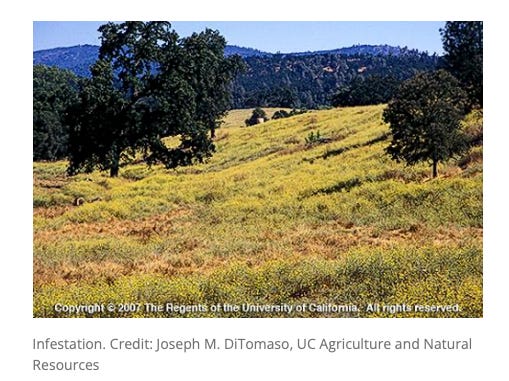
Today’s newsletter is all about starthistle, and all the ways you can control this summer weed…organically. If you want to read about chemical controls for starthistle, check out this University of California Ag and Natural Resources publication, “Yellow Starthistle” which also stresses cultural, physical, and mechanical controls (If only there were goat robots! Get started on that, Elon!)
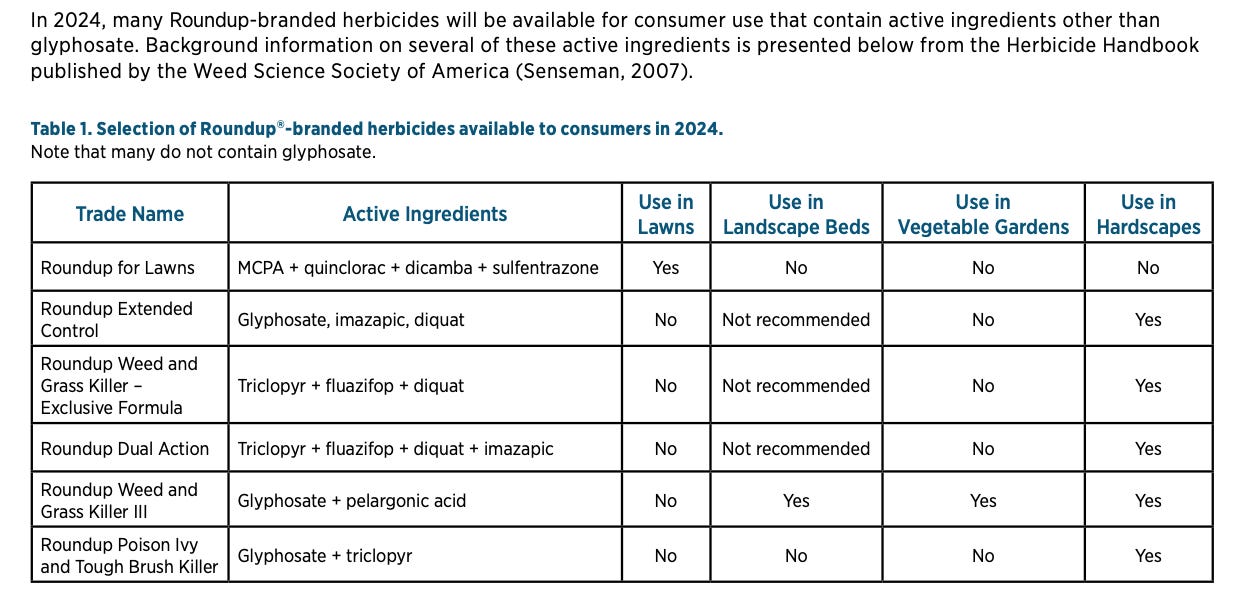
In today’s podcast (above), America’s Favorite Retired College Horticulture Professor and I talk about the chemical side of weed control products, including all the different formulations of Roundup that are on the market, but they all have very different tasks; some can even sterilize your soil, making your garden unavailable for weeks, months, - or according to Flower - years. We offer tips for using herbicides, as well. We mention a University of Tennessee Institute of Agriculture publication about the different Roundup formulations entitled, “UPDATE ON ROUNDUP-BRANDED HERBICIDES FOR CONSUMERS” that can help you decide, including this chart:
One national database for insecticide/herbicide/miticide labels is the U.S. Environmental Protection Agency’s webpage, “Pesticide Product and Label System.” It’s not the easiest site to navigate, but be persistent.
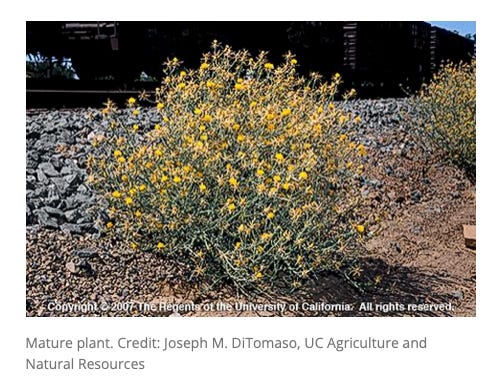
Starthistle Control Tips
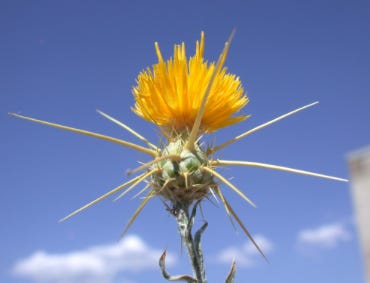
We are familiar with the TV commercials that feature happy children or romantic couples frolicking barefoot through the countryside. Property owners around here who witness such scenes must cringe, thinking about all the thorn-ridden yellow starthistle they would be stepping in this time of year, trying to figure how they could be possibly dumb enough to go frolicking through pastureland and open fields without foot protection.
Starthistle Is a Sticky Situation
Starthistle is an annual weed that grows from six inches tall to as much three feet, and is topped with a dandelion-like bright yellow flower surrounded by sharp spines.
Not only is yellow starthistle a threat to your skin, it is also poisonous to horses, causing a nervous disorder called “chewing disease” that is fatal once symptoms develop. How can you control this weed, which is commonplace in approximately 8-12 million acres of roadsides, rangeland, hay fields and pastures throughout California, and in all but 7 of the United States?
First of all, don’t unwittingly bring it on to your land. Yellow starthistle can be a contaminant in hay, especially grass hay; check your hay shipments by keeping the bales in one area and inspecting that area for starthistle seedlings.
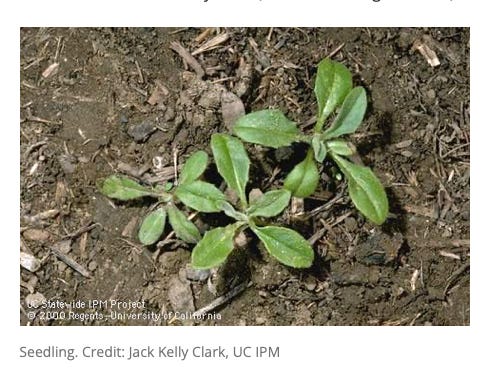
Till or disk areas with starthistle when the fall rains begin. Since starthistle emerges with these early rains, this is the best time to begin cultivation. Frequent mowings in the spring and summer will be necessary as well. Studies indicate that waiting to mow until about 2% of your starthistle weeds show their yellow flower color will result in less regrowth. However, yellow star thistle will regrow if there is still soil moisture and will need to be mowed again four to six weeks later.
Grazing sheep, goats or cattle will also reduce yellow starthistle seed produciton. There are four natural predators of yellow starthistle at work in our area: three weevils and a gall fly. Imported and released by the state department of Food and Agriculture throughout California, these predators attack starthistle seedheads, reducing the seed production, which is the only means of reproduction and spread of the weed. In areas where these natural enemies are at work, avoid insecticide use as well as control burning to give these insects a good chance of establishing themselves. Unfortunately, as of January of 2026, these insects have yet to provide a significant reduction in plant populations in most areas.
Finally, plant a cover crop to help choke out the starthistle population. That includes bunch grasses and wildflowers planted along roadsides, abandoned pastures, or natural areas. In actively used pastureland, grasses that are well adapted to our area make the best competitors to fight back yellow starthistle. These include subclovers, medics, orchardgrass and ryegrass.
Don’t expect quick control of starthistle, however. There are seven to ten years worth of starthistle seeds already in the soil, waiting to germinate.
On the bright side, according to the University of California, a positive quality of yellow starthistle is that bees produce flavorful, high quality honey when they forage on yellow starthistle.

PODCAST TRANSCRIPT: UNDERSTANDING HERBICIDE LABELS
Farmer Fred:
[0:00] Today’s podcast can help you decide how you want to kill the summer weeds chemically. On the other hand, today’s newsletter is going to help you attempt to control one of the nastiest of the summer weeds, star thistle, organically. Now, you may be personally aware of star thistle’s sharp spikes that are attached to the flower of the plants, especially if you have a habit of walking barefoot, wearing shorts while hiking, or if you do mountain biker gravel rides. Star thistle just inches away. Read the newsletter for everything you need to know about controlling star thistle. And by the way, it takes a multi-pronged and lengthy incursion to get a handle on a star thistle infestation. Today’s podcast and newsletter of the Beyond the Garden Basics is available for all subscribers, both free and paid. But if you become a paid subscriber, and I hope you do, you get access to the vast library of previous newsletter and podcasts here at the Beyond the Garden Basics. Paid subscribers also get priority access on garden questions answered and the ability to add comments. Paid subscribers, too, get an exclusive newsletter and podcast each Monday.
Recent episodes for paid subscribers included talks about easy care houseplants, what happens when you try to grow a fruit tree from seed, and finding alternative greens for your salad in the summer in areas like USDA Zone 9, where lettuce and spinach kind of tend to bolt and get bitter. But there are greens available, and that was in last Monday’s Beyond the Garden Basics newsletter, available again for paid subscribers. Becoming a paid subscriber also is more impetus for myself to keep typing and talking about gardening. And all I’m trying to do is break even, folks. It takes money to do research and keep the digital side of things alive and well. And I thank you for your ongoing support.
One more thing, Harvest Day, coming back to the Fair Oaks Horticulture Center, Saturday, August 1st, from 8 a.m. to 2 p.m. I still think this is the best garden event in Northern California, filled with practical advice on the best gardening techniques for backyard gardeners in our one-acre demonstration garden. Speeches, informative booths, lots of great people to talk to, lots of master gardeners to get information on your garden problems as well at Harvest Day at the Fair Oaks Horticulture Center in Fair Oaks Park, Sacramento County, Saturday, August 1st, 8 to 2. And by the way, it is free. It even has free parking. Come on by, won’t you? Saturday, August 1st. We’ll have a link in today’s show notes.
Farmer Fred:
[2:44] And now, recorded live with my good friend, America’s favorite retired college horticultural professor, Debbie Flower, recorded in the front seat of my van on a hot day, after looking at garden chemicals at a local garden center. Here we are talking about changes in a lot of herbicide labels that you should know about.
(originally aired in Garden Basics with Farmer Fred, Ep. 363, “Weedkillers Just Got More Confusing” Oct. 2024)
Farmer Fred:
Have you killed any weeds lately? On this episode of Garden Basics, we are going to talk about weed killers. The good, the bad, the dangerous. Debbie Flowers joining us, America’s favorite retired college horticultural professor. And Debbie, it takes just a quick little visit down to the local big box hardware store to realize that there is a wall full of weed killers out there. And even in the cleaning aisle, you can find unauthorized weed killers. And it has gotten more dangerous and confusing for gardeners.
Debbie Flower:
[3:40] Yeah, I was going to say looking at that wall of herbicides is more confusing than anything. There are a lot of them. A lot of them have very similar names. But when you read fine print, they’re not all the same.
Farmer Fred:
[3:54] That’s for sure. And what is even more confusing is one brand in particular, Roundup, has a lot of different formulations now for weed killer. Very few of them, if any, have what people have come to know as glyphosate, the active ingredient, which was the active ingredient in Roundup for nearly 50 years of its existence. But glyphosate is being phased out and it’s being replaced by a cornucopia of hard words to pronounce.
Debbie Flower:
[4:22] Yeah, glyphosate and almost synonymous with Roundup. I see comments on the internet that people say, what is Roundup? Is Roundup glyphosate? Well, yes, they’re the same thing. Well, that is absolutely not true anymore.
Farmer Fred:
[4:35] Yeah. And it’s very confusing. And the bottom line, we could sum this up and go away and have lunch. But no, we could just sum it up by saying, read and follow all label directions. And it’s more important than ever because of all the different formulations now of Roundup. It’s interesting that the owners of the brand Roundup now have phased out glyphosate only to replace it with other weed-killing chemicals, some of which are even, more dastardly than glyphosate in a lot of situations of the different formulations now of Roundup. There are some soil sterilants or at least chemicals that would tell you on the label in which you should follow. You don’t want to replant in that soil for anywhere from 14 days to, what, four months or more.
Debbie Flower:
[5:27] Well, the label will say four months, yeah, but tests done by universities have indicated it could take four years for that chemical to clear the soil and allow you to grow healthy crops or healthy landscape plants in that soil.
Farmer Fred:
[5:40] Fortunately, the University of Tennessee has come up with an excellent online page called Update on Roundup-Branded Herbicide for Consumers, and they point out that for decades, herbicides containing the active ingredient glyphosate have been sold under the trade name Roundup. These products are used for non-selective control of broadleaf and grassy weeds in landscape settings. Whether it be controlling problematic weeds in hardscapes, like those that pop up in driveways or patios, or in ornamental or vegetable gardens or renovating a lawn, Roundup-branded herbicides are used widely throughout the United States. Usage is so common that practitioners often use the term glyphosate and Roundup interchangeably. However, this common technology has been confusing in recent years because certain Roundup-branded products sold to consumers now contain herbicides other than glyphosate, which some may have not realized. How often have you decided to go down to the hardware store and get a package of weed killer? You know, you get Roundup because what, for the last 50 years, you know, it killed weeds. Well, it can do more than that if you buy the wrong formulation of Roundup. And there are several, we saw what, four or five different Roundup branded chemicals out there that can have very different purposes.
Debbie Flower:
[6:59] Yes, and some of them will kill everything to the point, and as you said, have a very long plant back time, meaning a time before you can plant more into that space. Yes. And unlike Roundup, which is tied up in the soil, once you apply it, some of these last a much longer time. And that’s what makes that plant-back time so long.
Farmer Fred:
[7:22] Explain tied up in the soil.
Debbie Flower:
[7:25] We’re dealing with chemicals. Soil has a lot of chemistry in it. And the chemical Roundup, when it hits soil particles, will react and become non-effective at that point. So, I mean, it won’t be absorbed by the roots of other plants, and you can put new plants and seeds even into the soil, and they will grow just fine.
Debbie Flower:
[7:47] But that’s not true of the chemicals now being used in bottles that say Roundup.
Farmer Fred:
[7:52] Let’s go into that cornucopia of tongue-twisting chemicals that might be in a bottle of Roundup now. One of the first is Diquat. Talk a little bit about what Diquat is.
Debbie Flower:
[8:04] First, we have to know how to read the label. So when you look at the front of an herbicide, these are herbicides because they kill plants, herbs, or any pesticide, there will be an active ingredient list. And it’s very small print. That’s where you want to look. And it will tell you what the active ingredients are, meaning the things that are going to actually, in this case, kill plants, and what percentage of the contents of the bottle are made up of that chemistry. And so you’ll see one word would be diquat. and what you want to understand about these chemicals are several things. One is, is it selective or non-selective? A selective herbicide will kill only some plants. A non-selective herbicide will kill or damage. It isn’t always death.
Debbie Flower:
[8:48] Only a certain group of plants like grasses or the broad leaves, anything that’s not a grass, anything that has a like clover in your lawn would be a broadleaf. Another category is the sedges. So you need to know if it’s selective, is it going to harm the thing you want it to harm? And is it going to not harm the thing you want to remain in your garden? So you look at the label and you see that it’s diquat. Diquat is non-selective. So that means it’ll kill those broadleaves and those grassy weeds, and it acts very quickly. So some of the herbicides take a little longer to act, and that allows them to become systemic, meaning they’re absorbed by the plant and move into the roots, and so they kill the plant from the roots all the way to the top. Diquat is not that way. Diquat acts so quickly that it just kills the top of the plant. So if your plant is a perennial and can die back and come back from a storage organ underground, this is not going to be the chemical for you.
Farmer Fred:
[9:53] And usually on these labels, there will be also in small print, a myriad of plants that you can apply it to. And remember, on any chemical label, if that plant is not listed, it’s probably not going to work on that plant.
Debbie Flower:
[10:09] Right. And the label is not necessarily what’s printed on the bottle. The label is the paperwork that’s kind of under plastic and tape. Often on the back of the bottle, it can be work to get into it, and it’s small print, as you said, so it can be difficult to read, but you need to do it to preserve the plants you want to preserve and kill the ones you don’t. The label is the law, meaning you have to use what’s in that container the way the label says. So it has to list both the weed you want to kill and the situation or plant that you want to preserve. So it might say kills grasses in landscape plants or kills broad leaves in a lawn. Then those are the situations where you can use that herbicide legally. As far as I know, herbicide cops who are going to drive into your yard and ask to see your herbicide and how you’re applying it and what you’re applying it to. So they do actually exist, though, for commercial applicators.
Debbie Flower:
[11:15] And commercial applicators can be cited and they could be fined. And if it happens enough, they could be put out of business. A commercial applicator has to have a license to apply the pesticides. You have to take a test. You have to do continuing education to keep that license. And the license will cover different categories that... That professional person can apply the herbicides to. So if you’re just hiring the kid next door to mow your lawn and you want them to apply some herbicide, that’s illegal. They do not have a license to do so. The license means you can apply it for profit or to earn something. It might not be money, it might be privileges of some sort. So be aware of that. But nobody’s going to come after you personally at your house to apply these pesticides.
Farmer Fred:
[12:00] Yeah, Diquat is just one of the several active ingredients you’ll find in most Roundup products now. It used to be the old Roundup, it would be glyphosate and inert ingredients. But now it’s usually three or four active ingredients. So like in the four versions of Roundup that contain Diquat, they also contain other tongue twisting chemicals too, like fluazepop or triclopyr, things like that. But Diquat, too, I could see the appeal of that in that it is rain fast within one to two hours after application. And if you’re threatened by rain a lot to have it be able to only need two hours of dry weather, that’s fine. And I believe glyphosate was six hours of dry weather you needed. So I could see where that could be a selling point. But there is a problem with toxicity, too. Acute toxicity of Diquat is greater than glyphosate, and that’s measured by what’s called the LD50. It’s not a model of a Ford, although maybe it should be, but what is LD50?
Debbie Flower:
[13:03] Well, toxicity is poisoning, and acute means poisoning due to one exposure of the chemical. And tests are done on animals, very commonly rats, with these chemicals, and they’re applied, And the LD50 is calculated, and that’s the lethal dose, thus the LD, that kills 50% of the population, thus the 50. Legal LD50, lethal dose to kill 50% of the population. You might say, why just 50% of the population? Why not wait till every one of them is killed? Well, there are differences in all living things about their sensitivity to these things. And so if you waited for them all to die, then, well, you’d wipe out the population for one. But it’s not a good test of what’s going to happen with that chemical. So they’re just looking at killing 50% of the population. So the LD50 is expressed in milligrams per kilograms. It’s milligrams of the active ingredient per kilogram of body weight. The smaller the number, the more toxic the chemical. If the LD50 is 30, it takes very little of the chemical. Milligram is a small number. Very little of the chemical to, and that’s for only 2.2 pounds, so to kill that rat as the tests are done. If as the number gets bigger, the chemical becomes less toxic, less poisonous to humans.
Farmer Fred:
[14:31] Yeah, let’s point out what all is in this publication from the University of Tennessee that updates people on Roundup-branded herbicides. And they have this chart. And it’s a very easy to refer to chart. We’ll have a link to this in the show notes today. And there are three products on this list that contain Diquat along with several other active ingredients. One is called Roundup Extended Control. One is called Roundup Weed and Grass Killer Exclusive Formula. And the other is called Roundup Dual Action. And then it has a column for, can you use it in a lawn? In all these cases, the answer is no. Can you use it in landscape beds? In this case, it’s not recommended. Can you use it in vegetable gardens? No. Can you use it in hardscapes? Well, yes. And that’s the problem with a lot of these new Roundup formulations is some of them are strictly for hardscapes, for patios. And you have to read and follow all label directions. You just can’t go grab a product off a shelf that has the prettiest Roundup label and take it home and think it’ll do the job. The problem is it might do such a good job that you would have to wait a long time before you could replant.
Debbie Flower:
[15:43] Yes. And the other thing about these Roundup products is they have very similar names. There’s Roundup Weed and Grass Killer 3. There’s Roundup Weed and Grass Killer exclusive formula. And they’re two different things. They have different active ingredients and they can be used in different situations. We didn’t see the Roundup Weed and Grass Killer 3. It contains glyphosate and pelargonic acid. We saw the Roundup poison ivy and tough brush killer those are the only two oh no there’s three here listed roundup extended control that have glyphosate in them glyphosate has been made illegal in other countries not in the united states in other countries and so as you can imagine that would limit the market for products with glyphosate in them and that may be the reason that the company is changing
Farmer Fred:
[16:33] I think glyphosate has put the fear of god in a lot of chemical companies because i notice on the other brands of weed killer up there. I didn’t see any with glyphosate that were current product. Now, we came across a few bottles of Roundup that look like they’ve been on the shelf a while that did have glyphosate. But other than that, it was all the new formulations.
Debbie Flower:
[16:53] Yes, we saw a few, very few that were glyphosate, the traditional product that Roundup used to produce.
Farmer Fred:
[17:00] What I don’t know is if this is a state mandate, that maybe California has stricter laws about glyphosate and other states do not. For instance, this publication from the University of Tennessee lists three Roundup products with glyphosate. And I think of all the ones we saw, I don’t recall seeing any Roundup products with glyphosate in it.
Debbie Flower:
[17:21] Well, just we saw the one looked like a really old bottle. You could barely read the label because it had like rubbed off. And then we saw, and that was a big container. And we saw one on the way in, in a display of a different kind of Roundup. The bottles looked very similar, but of the probably almost 100 bottles there, there was one that had glyphosate in it. So it is definitely not available. And as you said, the other brands did not have glyphosate in them either.
Farmer Fred:
[17:52] What I’m worried about with these new formulations of Roundup is the time you need to wait before you can replant. If you go into a bed and kill weeds thinking, okay, now I can put in the vegetables or put in a new lawn or whatever. There are time limits where you have to wait. Dicot does not list one. Fluazipop, though, does list a half-life of 15 days. That limits plant establishment after application. Tricloper talks about it’s, not readily absorbed as soil and can persist upward of 46 days in the soil. And then there are longer ones.
Debbie Flower:
[18:32] Well, it’s interesting that under the Triclopyr, although it says it can last up to 46 days, it varies by soil type. And so they’re saying you can establish a lawn from seed starting 14 days after application. That’s a lot different from 46. But you could be really disappointed and not get a lawn if you started it at 14 days.
Farmer Fred:
[18:54] Then there are some mystery ones. There’s another chemical called MCPA. And the average half-life of MCPA is five to six days, but it can persist in the soil one to six months based on soil moisture content. It’s amazing what you can find in a label.
Debbie Flower:
[19:10] It sure is. I hope people read this publication that you will attach to this podcast because it is very helpful. It’s done an excellent job of distilling the critical information one needs to know about these chemicals.
Farmer Fred:
[19:24] Another active ingredient that you might find in Roundup is called, I guess it’s pronounced Quinclorac. And it talks about Quinclorac can persist in soil for extended periods, limiting planting after application. In turf grass, it can be applied before planting but must be delayed upwards of 28 days thereafter until juvenile plants mature. Another active ingredient, Sulfentrazone, can persist for more than 120 days. And that’s true for another one called, you say it, Imazapic?
Debbie Flower:
[19:59] I don’t know. It’s a guess on my part, too. Imazapic sounds good. Broadleaf, everything, like broadleaf weeds, as we talked about, grassy weeds, and sedges, which are very difficult to control. And this has an average half-life of 120 days. So that means it can be active for 120 days after treatment.
Debbie Flower:
[20:19] So they, but it can last in the soil up to 48 months. That’s four years.
Farmer Fred:
[20:26] What happens when chemicals get into the soil? Can they spread by water and affect the roots of nearby plants?
Debbie Flower:
[20:32] That’s a potential, yes. That’s, and the other thing this talks about is, are these chemicals subject to volatilization? Volatilization means they turn from the form you put them in. In this case, they were all liquids to a gas. And so if you were to apply them underneath a plant that you like and want to keep, and they could harm that plant by volatilization, they can become a gas, rise up under the plant, and you will see the effect of the herbicide on the desirable plant.
Farmer Fred:
[21:01] One of the new Roundup products is called Roundup Extended Control. And the old formulations had glyphosate in it, along with imazapic and diquat. I’m sure that they have a new active ingredient, at least here in California, to add to that. And that’s basically, you can get the clue from the name extended control. That sounds like a soil sterilant. And sure enough, with imazapic and diquat in it, it’s going to be that period of time you mentioned that it could be before you replant. But in this situation, they think it’s more applicable for patios, hardscapes, driveways where the weeds are popping up. But I noticed on some of those labels, too, it talked about, Test a small portion to make sure it doesn’t stain your hardscape first.
Debbie Flower:
[21:48] Yeah, so you’re spraying the cracks. That’s where plants can grow. But there are chemicals that can cause the concrete or asphalt or brick or slate or whatever your hardscape is made from to discolor. So, yeah, that could be a real disappointment after you spent. These are not cheap chemicals after you spent many tens of dollars buying this
Debbie Flower:
[22:09] and then find out it’s going to stain your hardscape.
Farmer Fred:
[22:11] Yeah. And we’re not telling you not to use Roundup. What we’re saying is you have to be more careful now when buying Roundup. If you choose to use it and be sure to read the label that the plant is listed to be controlled on that label, don’t think, well, if it controls Bermuda grass, it can control crabgrass. Well, not necessarily. One other way to maybe help you if you’re looking for a lower toxicity formulation of Roundup is look at the signal word on the front of the label. And that’s very important, isn’t it?
Debbie Flower:
[22:47] Yeah, the signal word is very important. You’ll even see it on large bottles of things like bleach that are used to disinfect kitchens or commercial kitchens and other places. So, yes. And there are three of them classically. There’s some more used in the industry. but homeowners would not be exposed to most of those chemicals. And they are caution, warning, and danger. And when I taught pesticide and pest control, I would say, remember it by remembering “Cat Will Die” because, sorry, I have cats. I love cats. It’s just the words that came to my mind as a mnemonic, as a memory device. And it’s the order in which those chemical, those words, sorry, it’s the order in which those signal words are said that matters. Caution means it is the least toxic or the least poisonous warning is the middle and danger is the most toxic most poisonous to humans
Farmer Fred:
[23:45] Also too there will be portions in the full label if you can pry that plastic open to read it all about what you should wear if you’re applying it and that’s very important.
Debbie Flower:
[23:56] Yes it is and the The words I’m used to reading are long pants, long sleeves, shirts, socks, shoes, chemical-resistant gloves, and eye protection. Eye protection is critical. You only get one set of eyes. People don’t think about their eyes. Once you’ve hurt them, there’s no going back.
Farmer Fred:
[24:19] So read and follow all label directions. Choose very carefully the Roundup product that you choose to use to control weeds. I still like to use a hoe myself.
Debbie Flower:
[24:31] A hoe, between the cracks in the patio, I have a nice thin, it’s almost like a scythe, but it’s much smaller, curved blade that I can go in there and get things out with. It’s great. I time my gardening. I check the weather. If it’s going to be after a rainstorm, that’s when I go out and start pulling weeds. And pull the weeds when they’re young, before they set seed. Then they will not spread from seed. and they’re smaller. They’re a lot easier to get out of the ground.
Farmer Fred:
[24:59] Have you heard about mulch?
Debbie Flower:
[25:02] You see on my landscape? It’s buried in mulch. I use mulch regularly. I get the arborist chips and I get the pile in my yard and it takes me a long time to spread them, but I don’t mind. I have a place where I’m fine with them staying in a pile till I need them.
Debbie Flower:
[25:17] And things do land in the mulch and start to grow, but they’re really, really easy to pull out.
Farmer Fred:
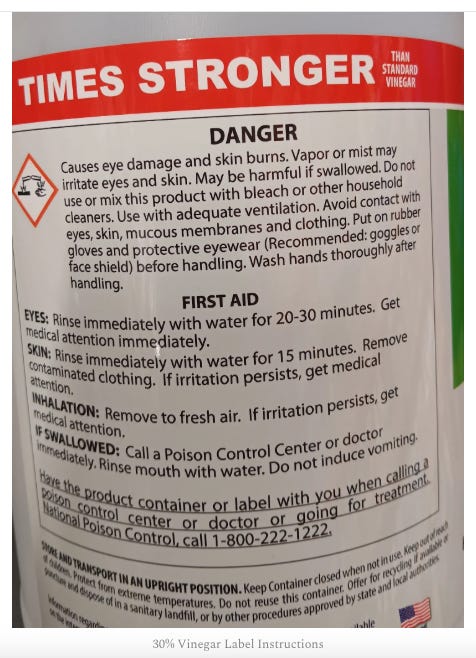
[25:24] Right. You can’t control weeds the old-fashioned way. Now, if you go on the Internet and start looking for what they might refer to as natural weed controls, and natural is kind of a nebulous word that nobody knows really what it means. And we discovered this going over to the cleaning aisle today at the big box store is the fact that, well, yeah, you can read on the Internet about using vinegar to kill weeds. But there are some formulations there in the cleaning aisle of vinegar that’s downright dangerous. In fact, the word danger is on the label of these bottles of 30% vinegar.
Debbie Flower:
[25:59] Yeah, this frightens me. I think this is incredibly dangerous. They talk about how it can be harmful to your hands, your skin, your eyes. Don’t breathe the fumes. Have windows open. And then they show pictures, not on the bottle as much as on the cardboard box holding the bottles in the display of people applying, spraying the vinegar on something and have no gloves on. That’s dangerous. It’s an acid. It’s a very strong acid, and it will burn your skin instantly.
Farmer Fred:
[26:32] The display we saw of 30% vinegar bottles, and they’re in one-gallon bottles, was its own display sitting basically in the middle of the aisle. So, you know, they want to sell it. And naturally, they have the open, not the open, open bottles, but at least the display bottles out there and the cardboard container that they came in or underneath it with replacements. And on the side of that cardboard box, it was written for horticultural uses. Well, wait a minute. Have you read the label of 30% vinegar? I mean, that word danger is going to pop out at you, but does it say anywhere in there in uses about... Putting it on plants? No.
Debbie Flower:
[27:12] In order for it to be legally used on horticultural crops, it has to be registered as a pesticide. And that’s a long, expensive process. It has to be done at the federal level through the Environmental Protection Agency. And once it is accepted and it takes research to show that it does what the company says the herbicide will do, there have to be a certain amount of research that shows that it does that. It has to be tested, like I said, on rats to see what the LD50 is. Sometimes it’s done in the eyes of bunny rabbits or other things. But by doing those tests, they can tell what the reaction is going to be on a human. And that’s been done for you when it’s registered as an herbicide or a pesticide, and it will have an EPA registration number. This vinegar does not have an EPA registration number. Nobody has tested it to see what it really will or won’t do. And once it’s registered at the federal level, each state goes and decides if they want to allow it to be used for the horticultural applications that the company has said it is good for. So it goes through another set of testing. It’s a many, many year process. It’s accountability that these chemicals do what they say when used according to label directions. Vinegar is a chemical. It is chemical control if you are using it in your garden. There’s no way around that.
Farmer Fred:
[28:35] And if you bother to read the label of that cleaning 30% vinegar, it’ll warn you away. It says it causes eye damage and skin burns. Vapor or mist may irritate eyes and skin, may be harmful if swallowed. Avoid contact with eyes, skin, mucous membranes, and clothing. Put on rubber gloves and protective eyewear. If in eyes, get medical attention immediately. If swallowed, call a poison control center or a doctor immediately. So basically, if you’re applying 30 percent vinegar, you better have a hazmat suit.
Debbie Flower:
[29:08] Yeah. And if you’re the person around someone who’s applying it, just listen for the screaming, because if it touches their skin, if it gets in their eyes, if it gets up their nose, they’re going to be screaming. It’s going to be very painful.
Farmer Fred:
[29:20] Unfortunately, from a bureaucratic standpoint, it is unfortunate that vinegar is labeled as an organic pesticide. It’s suitable for organic uses. The problem is it’s not the best choice to make
Farmer Fred:
[29:34] because it is so dangerous to the person applying it and because of its volatility.
Debbie Flower:
[29:40] If it’s labeled as a pesticide, it will have a pesticide registration number. It will have a label. And then you can also look up something called the MSDS on any pesticide. It has some material safety data sheet, MSDS. And it goes on for several pages. It tells you what the LD50 is. It tells you what the signal word is. It tells you what you need to wear to apply it, how it breaks down, and the chemicals it becomes when it breaks down in the environment, what happens when it goes in water, if it’s explosive, if it catches fire. It has all this additional information about these pesticides. And so if you’re really concerned about exposing yourself, get your MSDS and see what you’re exposing yourself to.
Farmer Fred:
[30:26] This particular MSDS for this 30% vinegar says besides you and your skin, vinegar can also damage desirable plants, cause etchings or discoloration in metal or wood, spotting on concrete and damage to your clothes. And the vapors, according to the MSDS, can cause irritation to the upper respiratory tract and mucous membranes. So I’m not kidding about wearing a hazmat suit.
Debbie Flower:
[30:52] Right. Respirator sounds like respirator would be useful if not required. Certainly useful.
Farmer Fred:
[30:58] Does it have the word danger on it? Yes. If you look at that bottle in the cleaning aisle, there’s the bottle and it says danger right there in big print. And on the front of the label, it says poison. It’s like, well, do you really want to clean? I wouldn’t want to be in a shower stall trying to clean out a shower stall with vinegar, 30 percent vinegar.
Debbie Flower:
[31:18] I wouldn’t either. I absolutely wouldn’t.
Farmer Fred:
[31:21] And even though you would be watering it down to whatever the recommended concentration is, it would still be behoove you to wear facial protection.
Debbie Flower:
[31:32] Yes, absolutely.
Farmer Fred:
[31:33] So even though vinegar might be organic or natural. Oh, by the way, it doesn’t do a very good job killing weeds. It’s just top kill, isn’t it?
Debbie Flower:
[31:42] Yes, it is. It is not a systemic. It just kills the top of the plant and doesn’t get into the roots. And so if it’s a perennial plant, then it’ll be back.
Farmer Fred:
[31:51] Yeah, so it’s temporary at best. Yes. You might be better off using a flame weeder.
Debbie Flower:
[31:56] Or boiling water.
Farmer Fred:
[31:58] There you go, boiling water. So then you only have the chance of scalding yourself.
Debbie Flower:
[32:02] Isn’t that the truth? And with the flame weeder, you can catch on fire. There’s no win here.
Farmer Fred:
[32:07] Well, there’s the hoe.
Debbie Flower:
[32:09] There’s the hoe. Yes, yes. Just lay it down correctly on the ground with the blade turned down so that you don’t step on it and have the handle come up and hit you in the head.
Farmer Fred:
[32:18] And as long as these products are legal for sale, which I find amazing, but as long as they’re legal for sale, You know, I can’t tell you not to use it, really, but I can tell you there’s a lot of good things you need to do before you use it. And at the top of the list, read and follow all label directions. Remember, if you forget to put on that face mask or whatever, or protect your skin or whatever, the label is the law and your case won’t hold up in court.
Debbie Flower:
[32:51] That’s absolutely true.
Farmer Fred:
[32:52] Now, remember, most of the information, most of the labels we’ve been talking about are online, and that’s a lot easier way of reading the full instructions without attempting to peel back pages of plastic that are going to tear or, getting out a strong magnifying glass to read it. You can go online, and you can also go online to find a lot more information.
Debbie Flower:
[33:15] Yes, there are many places you can find something about how to read a pesticide label. I would Google that, how to read a pesticide label, and I’d put .edu so that you’re going to get from schools, from educational institutions, how to read the pesticide label. And again, the label’s the law, and it has to be written in a way the law says. So this would be a very helpful thing to have when you’re reading labels so you know what everything means on that label.
Farmer Fred:
[33:45] Ain’t life grand in the 21st century? Things are changing. Read and follow all label directions. But enjoy gardening.
Debbie Flower:
[33:52] Yes. Yes. Be safe. That’s really important. And keep your plants safe. Enjoy what you do.

Thank you for also listening to the original Garden Basics with Farmer Fred podcast, with over 400 podcast episodes available for your listening pleasure. Find it wherever you get your podcasts.
Fred Hoffman is also a University of California Cooperative Extension Master Gardener in Sacramento County. And he likes to ride his bike(s). Especially downhill.