

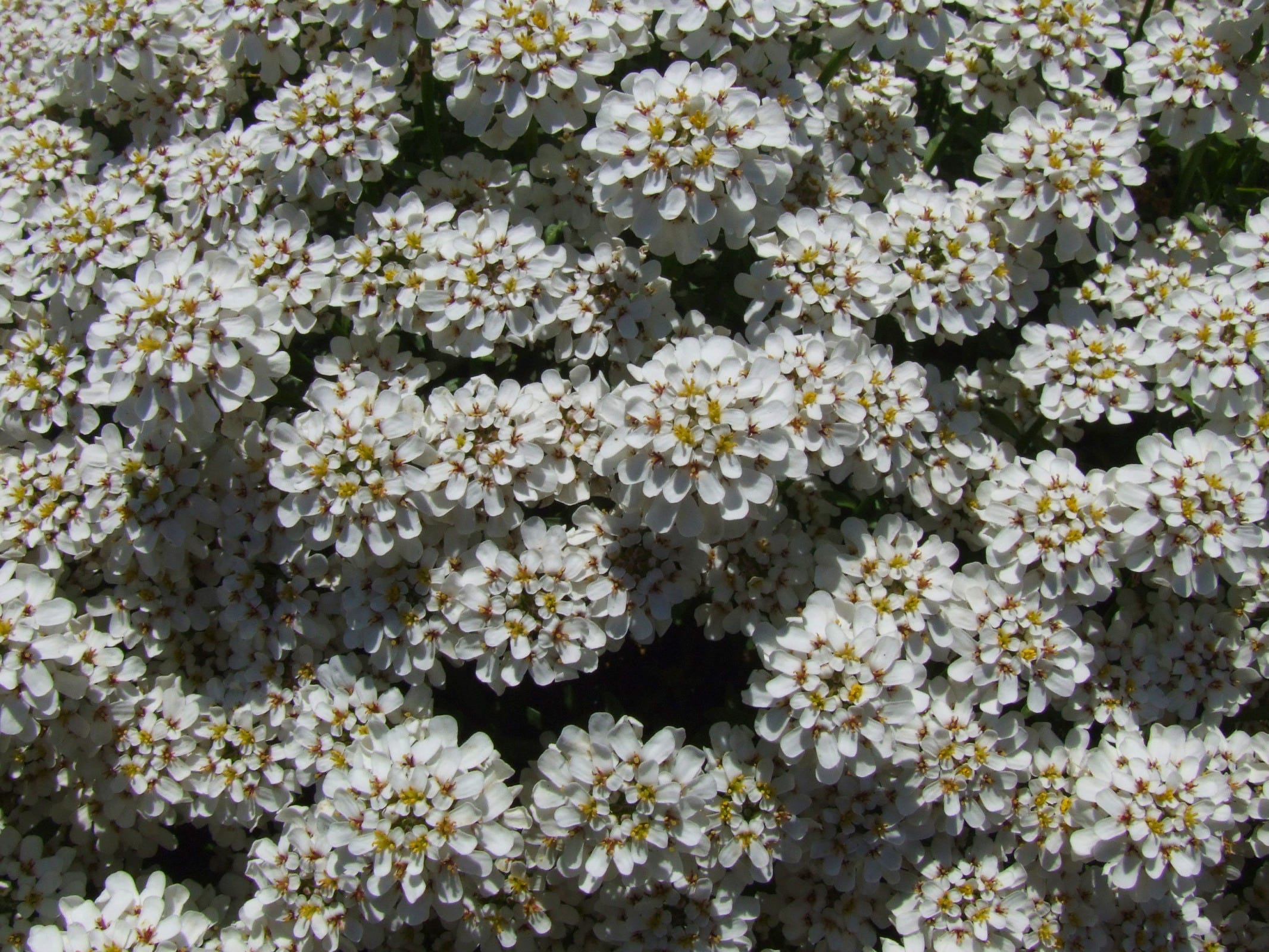
If you were a paid subscriber, you would have received this post several weeks ago, when there were tons of candytuft plants at the nursery! Now? Good luck. That’s just one of the perks for paid subscribers to Beyond the Garden Basics. Thank You for your support.
Today we’re diving into a plant that I should be more familiar with — candytuft, or Iberis sempervirens - if you want to get fancy about it. This little evergreen perennial (in milder zones) has a surprisingly rich history, going all the way back to ancient Greece and Rome, and it turns out it’s just as at home throughout most of the United States and Canada as it ever was back then.
I’ve got Master Gardener Carrie Hansen joining me, and honestly, she knows this plant inside and out. We talk about why candytuft is such a great choice if you’re dealing with drought conditions — because let’s face it, water conservation is always on our minds out here in California (and in a lot of other places, as well) — and how those beautiful clusters of white flowers make it as pretty as it is practical.
Carrie also shares some really useful maintenance tips, including when and how to shear it back to keep it nice and full. We get into the different varieties within the Iberis genus, which is a bigger family than most people realize, and even touch on how it was used medicinally throughout history — pretty fascinating stuff.
Bottom line? If you’ve got a sunny spot that needs a tough, good-looking ground cover, candytuft might just be your new best friend. Give a listen to the podcast or read the transcript, here.
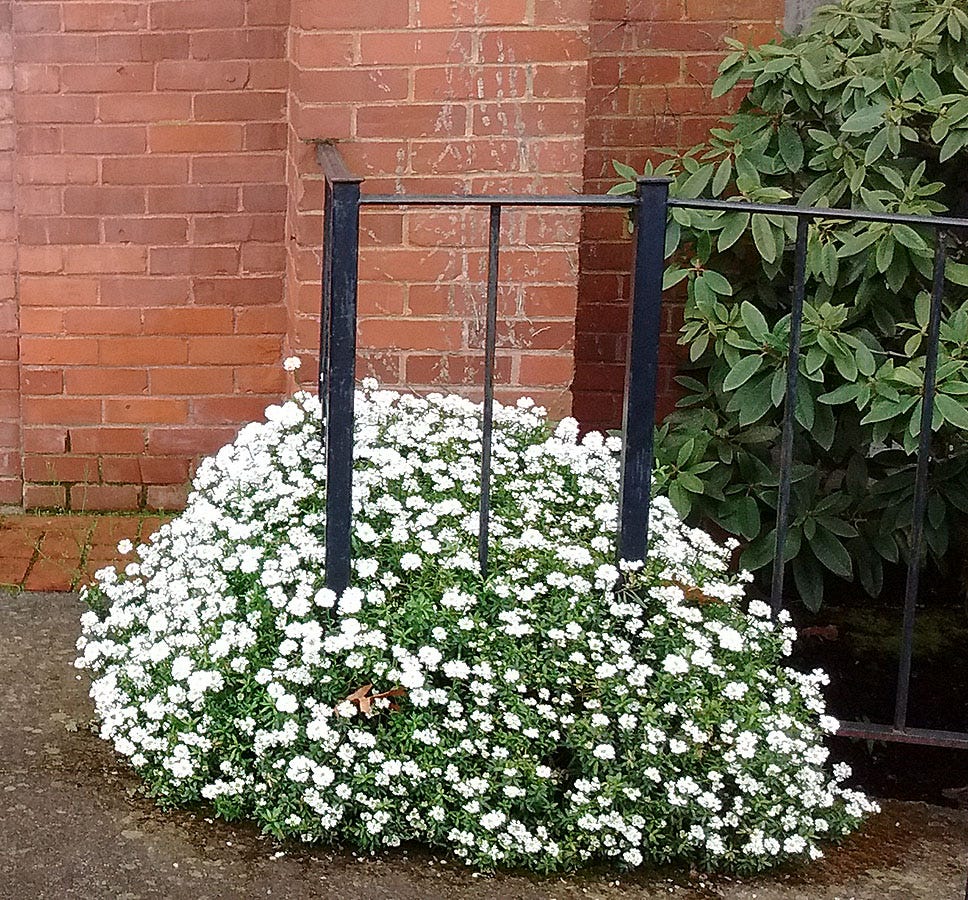
Resources for More Info about Candytuft:
El Dorado County Master Gardeners Cottage Garden
North Carolina State Extension Gardener
Oregon State University Dept. of Horticulture
Plantura Magazine (including propagation methods)
Candytuft TRANSCRIPT
Farmer Fred:
[0:00] Today, we’re going to talk about a plant that really goes back a long time. The ancient Greeks and Romans used to use it for medical purposes. It was introduced to England in 1587. It is a native plant to a large part of the Mediterranean area of Europe as well, and it’s putting on its show right now in a lot of the country. It’s an old plant, but I think it certainly deserves more recognition and more use here in our area of Northern California, as well as other areas of USDA Zone 9, where theoretically it’s not supposed to succeed, but I’m here to tell you, it does succeed. We’re talking about candytuft, Iberis sempervirens, to be exact. It’s an evergreen candy tough. What about it?
Farmer Fred:
[0:50] What’s up with that? Well, we will now turn to our resident candytuft expert. It’s Master Gardener, Carrie Hansen. Carrie, that was an excellent article you wrote for the Master Gardener newsletter all about candytuft. And so what do you know about it?
Carrie Hanson:
[1:08] Well, first, thank you for that compliment about the article. We recently planted some candytufts in our horticultural center, Farrokes Horticultural Center, our demonstration gardens there. And that’s why I wrote that article, is it seems so timely. Plus, at that time, that would have been February, March, it was in full bloom. So what I like about this plant is it is well adapted to our Mediterranean climate. It prefers drier soil. It is drought resistant. Once it’s established, it has pretty little blooms. It’s this, sort of delicate, airy-looking little plant. Very teeny tiny blossoms that cluster together and cover the entire plant when it’s in bloom.
Carrie Hanson:
[1:57] Kind of oblong, narrow leaves that look very fern-like. So it looks delicate. It is a tough plant. Very resistant to most diseases, most pests. It might have a little bit of damage from slugs, but mostly it’s even it’s supposed to be deer resistant. We haven’t had a chance to really test that at the Fair Oaks Horticultural Center because we don’t have a deer problem, but many sources claim that it is deer resistant for those of you in the foothills. Another thing I really like about it is the little white blossoms really pop out. If you were to plant this along a border, it would lead the eye up with these bright spots of white.
Carrie Hanson:
[2:42] It’s also, it’s sort of one of those, what is the trio in a container planting? I think it’s a thriller, spiller, filler. It can be both filler and a spiller. It does root when it comes in contact with the soil, but it’s not aggressive. It’s non-invasive, but it will cover up that little bare spot in your garden and suppress weeds.
Farmer Fred:
[3:07] It is a border plant because of its eventual size. We’re talking again about the Iberis sempervirens, which is the most common candytuft around. And it doesn’t get that tall, doesn’t get that wide. And it does spread, but it’s not an invasive plant. How the heck does that happen?
Carrie Hanson:
[3:25] Well, that’s correct. It really only gets to be about maybe 12 inches in spread, maximum 12 inches high. But also, what you want to do to help contain it is after it’s finished with blooming, you give it a good shearing, reduce the size by about a third, and that will keep your plant dense and compact.
Farmer Fred:
[3:46] Will it bloom again after that shearing?
Carrie Hanson:
[3:48] You know, I’m not sure, but I don’t think so. One example of it, though, at the Fair Oaks Horticultural Center, we have the new plantings, which are in what we call the pop garden, our popular plants garden. As you go into the center, you make a left, and it’s there on the right-hand side, mingled in with other plants. Those candytufts are sited in a more dappled shade environment. There is another one that’s older that’s been there a few years, and it’s right as you come in the gate, it’s dead center in what they call the welcome garden. And it’s been there maybe three years, it gets a lot more sun, and I noticed this year, it could just be because this was a more established plant, but I noticed that this year that older plants blooms lasted longer than our new plantings. And it’s interesting, too, because the new plantings, we planted them in, I think we dug in about three inches of compost into the native soil. And so we amended it pretty extensively. However, the older plant is in, I don’t think there was any amendment to the soil. It was just placed in there. There are succulents around it. So there are a variety of things that grow well in the same sort of not very rich environment.
Farmer Fred:
[5:12] There’s certainly a lot of varieties of the Iberis sempervirens, the evergreen candytuft that you can buy by name. There’s Alexander’s White. There’s Little Gem. Kingwood Compact is one, Purity, Snowflake. Sounds like they all have white flowers.
Carrie Hanson:
[5:30] Well, actually, white, I think, is the most common, but it also comes in pink and purple.
Farmer Fred:
[5:36] Yeah, I’ve been reading about some of these candytufts that do have the different colors, and one is the Globe candytuft, the Iberis umbilata, and it’s for all zones. It’s an annual. It’s a bushy plant that gets about 13 inches high with flowers in pink, rose, carmin, crimson, salmon, lilac, and white. And they also have dwarf strains called dwarf fairy and magic carpet, which are available in the same colors that only grow to six inches tall. So you do get the different colors of the flowers if you choose a different species of Iberis.
Carrie Hanson:
[6:10] Right. And we went in the horticultural center, we went straight ahead with the, again, this is in the popular plant section. So we went with the most widely available one, which is just straight ahead candy tough white flowers a little bit larger than the dwarf varieties you were talking about that garden is to highlight plants that are popular and do well in our area i.
Farmer Fred:
[6:34] Was trying to do a little bit more research on how the greeks and romans the ancient Greeks and Romans used candytuft, Iberis, for medicinal purposes but it wasn’t the sempervirens that they were using, apparently. It was the Iberis amara, A-M-A-R-A. And that was the one that they were using for gastrointestinal disorders. But I’m not sure that you’re going to find that in many places. Just because I’m referring to my medicinal plant books, there are no references to candytuft at all.
Carrie Hanson:
[7:10] Yeah, I’m not sure how widespread that would be, that native variety there. I did see where it was used for, well, candytuft in general, Iberis, for medicinal purposes. But I’m always a little reluctant to make those kinds of recommendations because I don’t know enough about that aspect of that.
Farmer Fred:
[7:31] And besides that, University of California would slap you on your wrists if you did.
Carrie Hanson:
[7:35] Right.
Farmer Fred:
[7:37] The Iberis sempervirens, though, is the one you’re going to find at the nurseries. Correct. And everything I read about it says it really wants to stay on the dry side. It doesn’t like wet feet because it is susceptible to root rot.
Carrie Hanson:
[7:52] Correct. Yes. Of course, you know, with all drought-resistant plantings, you want to get them established first so that first year maybe keep it watered a little bit more regularly. And another thing is, here it likes a drier environment, and yet it is green all year round. So, drought-resistant gardens are not necessarily barren, sterile things. You can have a lot of green using a plant like this one.
Farmer Fred:
[8:22] I guess we’re sort of the test kit, if you will, for finding out just how much heat and sun this plant can take. And I’m thinking that maybe it too is a candidate for moving plants that have a reputation for being for full sun, move them to areas where they’re going to get late afternoon shade to sort of mitigate the heat problem. But it sounds like that at the Fair Oaks Hort Center, you’ve got some in both full sun and in dappled shade. And I’m wondering if there’s a big difference in the flowering abilities of both.
Carrie Hanson:
[8:59] Well, again, I’m not sure if this was because the one plant that gets more sun, is a more established plant, but I noticed that the blooms did last longer. And in my research, I learned that they tend to bloom more profusely in the sun, the more sun they get. The ones that are in more of the shade, they do get some morning sun, but they’re also under a lot of larger trees.
Farmer Fred:
[9:27] And because it does bloom early in the season, if you will, in April and May, the flowers are less likely to suffer from the ravages of heat because they’ll be gone by August.
Carrie Hanson:
[9:40] Well before August. They’re mostly gone now, actually. The ones that were newly planted, I was there about a week ago, and they had already lost all their flower petals. And that would be the time to shear them back a little bit. The one that was getting more sun, the more established plant, it still had blooms, but you could tell that they were fading. So that would have been March or early April. Now we’ve had sort of an unusual late winter, early spring.
Farmer Fred:
[10:11] Ain’t that the truth? Yes.
Carrie Hanson:
[10:13] So we had some bursts of very warm days and that may have caused them to go through their cycle a little bit more quickly.
Farmer Fred:
[10:22] Yeah, it was in the upper 80s. Some locales even got into the low 90s. So, if this plant, especially if this is a plant that is going to start putting on its show in late winter, in March, then in that case, yeah, it’s no surprise then if there is a sudden burst of heat that would cause the flowers to fade. Exactly.
Carrie Hanson:
[10:42] In fact, I think they were blooming in February. Oh, okay. February, March. Yeah.
Farmer Fred:
[10:47] All right. So, instead, I mean, a lot of references you read about Candytuft, it talks about it being an April-May bloom. Yes. You’re finding it in February and March here.
Carrie Hanson:
[10:58] Well, this year, for sure, yeah. But on the other hand, it does attract certain pollinators. So it’s good in terms of providing some early season food.
Farmer Fred:
[11:09] Yeah, exactly. The early bird gets the worm in this situation. If on a warm, suddenly warm March day, all of a sudden the bees are out, they’re going to look for blooms. And I imagine the candytuft might be one of their favorites.
Carrie Hanson:
[11:23] Right, there it is.
Farmer Fred:
[11:24] Now, the people up in Oregon would disagree with you about its munchability to Bambi and her friends. They’ve referred to it as “deer candy.”
Carrie Hanson:
[11:34] I saw that, yes. That was the only source that said it was a problem with deer or that deer liked it. Most of the sources that I read said it was deer resistant. Again, I can’t really answer to that from firsthand experience. We don’t have a deer problem at the horticultural center, but it’s reputed. But it’s allegedly deer resistant.
Farmer Fred:
[11:57] Depends how hungry the deer are.
Carrie Hanson:
[11:59] I guess.
Farmer Fred:
[12:00] All right. So you might want to protect it. With a trap crop, if you live in deer country, where you have something on the outer edges of your property that the deer really like and they won’t bother coming in for more. But good luck on that.
Carrie Hanson:
[12:15] Right.
Farmer Fred:
[12:16] Now, obviously, a lot of people don’t live in USDA Zone 9. So for people who live in colder and wetter climates, this plant is hardy, supposedly, down to USDA Zone 3 or 4. So that means most of the United States can grow candytuft either as an evergreen in the milder zones or as an herbaceous perennial in the colder zones. But they all reference the fact they don’t like wet, poorly drained soils, which can lead to crown rot. And I guess in more moist climates, there are additional potential problems.
Carrie Hanson:
[12:55] Right. Downy mildew, powdery mildew, gray mold, fungal infections. But in our climate, we don’t have quite that same issue. Again, you don’t want to overwater it. It doesn’t want to be in wet soil or heavy soil, poorly draining soil.
Carrie Hanson:
[13:14] But if you allow it to dry out, it should be resistant to most of those problems.
Farmer Fred:
[13:19] And this would look terrific in a large container, too, especially as it spills over the sides.
Carrie Hanson:
[13:25] And it looks good in a rock garden. I love the way those white flowers contrast nicely with a dark background as in a rock garden.
Farmer Fred:
[13:34] And just about as with for any plant, it’s also a favorite of slugs, snails, and caterpillars.
Carrie Hanson:
[13:40] Unfortunately.
Farmer Fred:
[13:42] Yes. The University of Missouri and their botanical garden agree with you that deer tend to avoid this plant, and they even include rabbits as avoiding the plant.
Carrie Hanson:
[13:52] Right, right. Again, we don’t have a deer or a rabbit problem at the Hort Center, so I haven’t, I can’t answer that firsthand, but it is reputed to be deer-resistant and rabbit-resistant.
Farmer Fred:
[14:05] We’re talking about Iberis, candytuft, here. It’s excellent for borders, for paths, for walkways in rock gardens. It’s beautiful sprawling over a wall. It’s a great ground cover for small, sunny areas. And for containers as well. It’s a plant that goes back for centuries. Try it in your garden, too. Thanks for the great information. It’s Carrie Hanson, Sacramento County Master Gardener. Good info about Candytuft, Carrie.
Carrie Hanson:
[14:33] Thank you, Fred. Thank you for having me.
Fred Hoffman is also a University of California Cooperative Extension Master Gardener in Sacramento County. And he likes to ride his bike(s).