

Today’s podcast on Beyond the Garden Basics is all about grapes. We have a couple of interviews in the podcast with two Sacramento County UC Master Gardeners, who specialize in grape selection, planting, trellising, feeding, watering, protecting, pruning, and harvesting both wine grapes and table grapes.
And if ever there was a podcast that screamed for grape pictures, charts, graphics, and more… it’s this one. To the rescue is today’s Beyond the Garden Basics newsletter. We’ll have more explanations about what we talked about in the podcast, including diagrams explaining the various pruning techniques for grapes, best performing grape varieties, and links to grape growing advice from universities throughout the country. And all that info will be interspersed strategically into the podcast transcript, which kinda makes sense, to me. Let me know if it makes sense to you.
Battling Diseases and Extreme Heat on Grapes
Farmer Fred: Today’s podcast here on the Beyond the Garden Basics is all about grapes. We have two interviews with two Sacramento County-based UC Master Gardeners who specialize in grape selection, planting, trellising, feeding, watering, protecting, and harvesting both wine grapes and table grapes. You’re going to discover the best disease and heat-resistant varieties, the best tasting grape varieties, and detailed information about pruning both table grapes and wine grapes.
Farmer Fred: And if ever there was a podcast that screamed for accompanying pictures, charts, graphics, and more, it’s this one. To the rescue is the original newsletter that contains this podcast, Beyond the Garden Basics, which you can find with an easy search, or just go to Substack.com and type in Beyond the Garden Basics.
In today’s newsletter, we’ll have more explanations about what we talk about in the podcast, including diagrams explaining the various pruning techniques for grapes, the best performing grape varieties, as well as links to grape growing advice from universities throughout the country.
Yeah, there is a catch. Paid subscribers get the complete podcast and newsletter, along with a human-reviewed transcript (that would be by me). Free subscribers get a partial podcast, and they will bump into a paywall in the newsletter about halfway through.
Paid subscribers get full access to the complete library of Beyond the Garden Basics podcasts and newsletters. Subscriptions are reasonably priced at $5 a month or $50 a year. And your support helps keep the newsletter and podcasts alive. And by the way, it helps keep me alive, too. I appreciate your eyes and ears here on the Beyond the Garden Basics newsletter and podcast. Thank you very much.
GRAPES vs HEAT, DISEASE & PESTS: STRATEGIES
(recorded in summer 2022)
Farmer Fred: Here at the Fair Oaks Horticulture Center, they’re trying new varieties or old varieties of grape vines, both table grapes and wine grapes, to find those that are more disease resistant. We’re talking with Catherine Barkett, Master Gardener here in Sacramento County. She’s in charge of the grapes here, building beautiful trellises and introcducing new varieties. Now, tell us about these new varieties and why they were chosen.
Catherine Barkett: Hi, Fred. We have been looking for varieties of grapes that don’t require a lot of a spray and are somewhat resistant to powdery mildew, which is a very common problem here in Sacramento, as well as other diseases of grapes. And we’ve looked all over the United States for different cultivars. Some are coming out of the University of Arkansas. They have a really good program there for growing disease-resistant grapes. And so we’ve selected five new ones, which are all now, I would say, between two and three years old. There’s a Crystal, which is a green grape. It has seeds, and it’s excellent for home use. It makes delicious white grape juice and also jams.
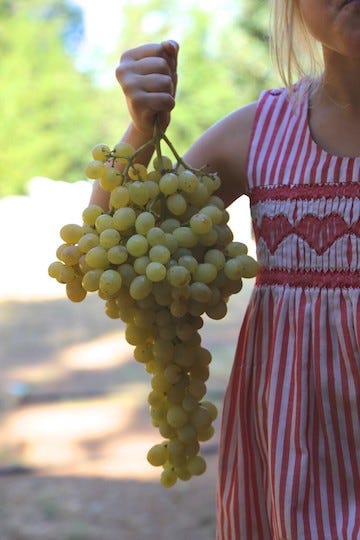
(FREDNOTE: “Crystal” may refer to several grape varieties that share the name or a version of the word “Crystal”. One is a local find in the Sierra Nevada foothills, and is now propagated by the Felix Gillet Institute. This particular “Crystal Grape” in the picture was found in Newcastle (CA) on what used to be part of the Fowler Nursery, started in 1912. This is one of Mark’ Fowler’s favorite grapes. He has been discovering and stewarding old plants from Gold Rush homesites for decades. This grape has been growing for over 100 years. Mark’s grandfather said that these grapes were experimental and called them ‘crystal grapes.’)
================
Farmer Fred: That’s Crystal.
Catherine Barkett: Crystal. And that, by the way, is a very old vine. We have hope, which is green, has no seeds, also excellent for home use. And it’s thick-skinned and very high-yield with sort of a medium-sized berry. Mars is mildew-resistant, very good for jam, has kind of a Concord, has that Concord flavor to it.
Farmer Fred: Is it seeded?
Catherine Barkett: That one has no seeds and is kind of a bluish-red color. It’s interesting. September, October ripening. So if you’re looking for something that ripens late in the season, that would be a good one. Mission is a really interesting wine. It came out of Spain initially and was brought to Mexico. And is grown in Mexico. And then the Catholic priest brought it to California, and they grew it in every mission in California.
Farmer Fred: Hence the name.
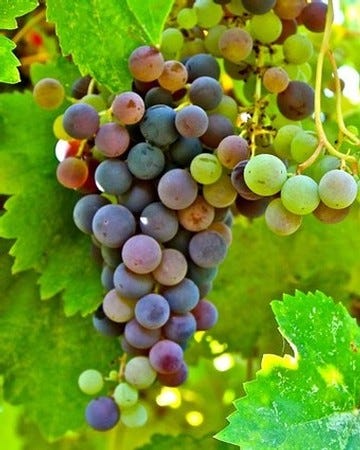
(FREDNOTE: “Mission” is considered by Lodi Wine.com as the variety that just won’t go away. They note: “…one must add that the Mission is not a distinguished grape, especially for table wine: it is low in acid and lacks distinctive varietal flavor. Even without direct evidence, we are fairly safe in concluding that the dry table wines, both red and white, made by the mission fathers were, at best, rather flat and dull.
Mission, however, never really disappeared. In 1984 the USDA California Field Office reported that there were still over 3,000 acres of the grape planted in the state. Latest reports show 404 acres, although there are many old vine plantings throughout the state, including Lodi, where smatterings of the grapevine can still be clearly identified, especially among blocks planted mostly to Zinfandel. There are a few, albeit tiny, blocks in Amador County dating back to the 1850s and 1860s devoted entirely to Mission. It’s a grape that refuses to die.”)
Catherine Barkett: Yeah, right. And it was used for their sacramental wine, for a kind of a red table wine, and also a fortified wine.
Farmer Fred: And it does have seeds.
Catherine Barkett: That one does have seeds. And it actually, I read on Wikipedia that before Prohibition, This grapevine in California produced 30 million gallons of wine.
Farmer Fred: That’s a lot of hooch.
Catherine Barkett: During Prohibition, it suffered badly because, first of all, the vines were neglected because you couldn’t make wine anymore. And Prohibitionists evidently were coming around destroying farmers’ vineyards. And one creative farmer planted sagebrush all around his vineyard to camouflage it.
And last but not least, Reliance, which is a very vigorous vine, excellent for home use. And that does not have seeds. And it’s kind of a pink color.
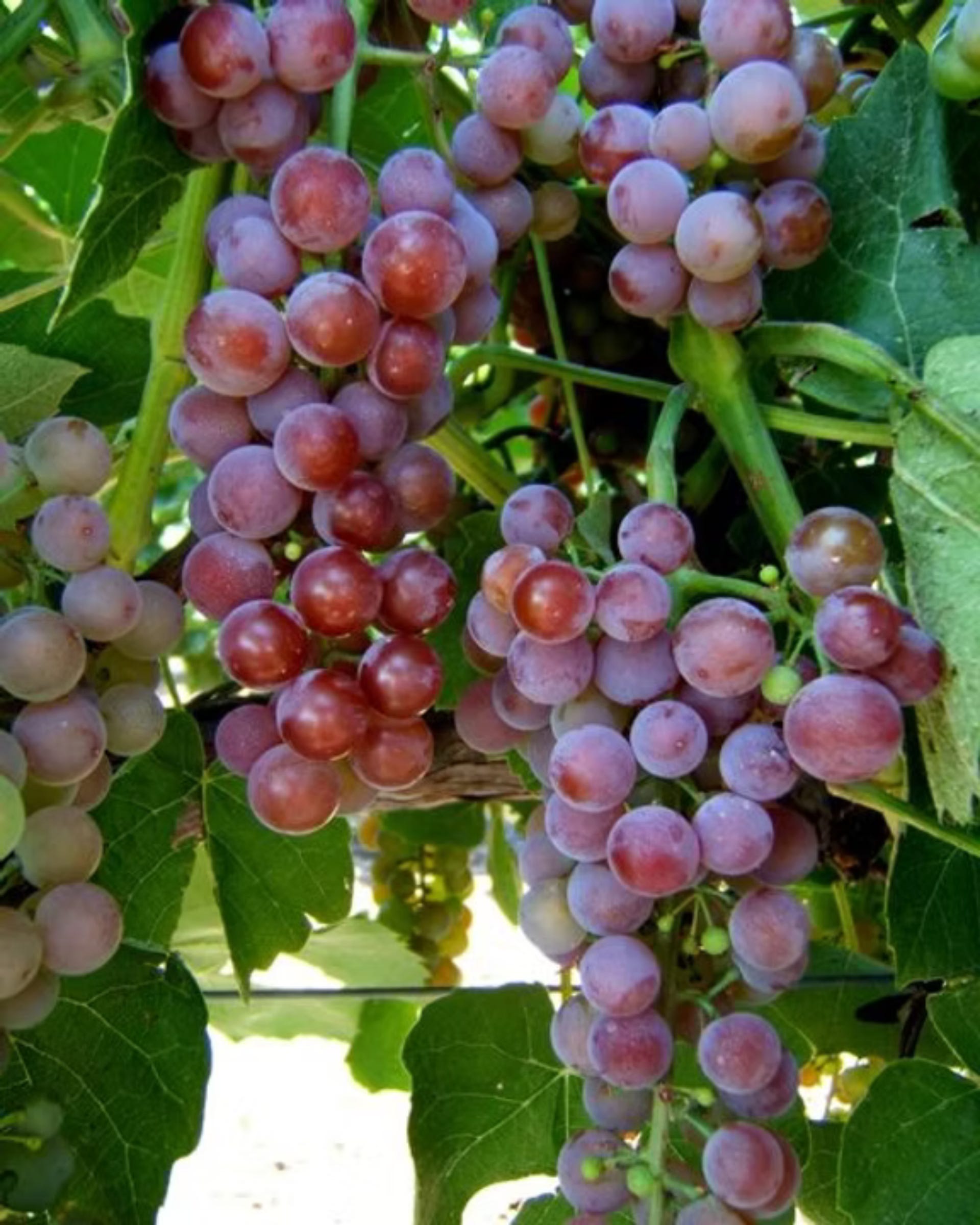
Farmer Fred: Which is fun. Is that a wine grape or a table grape?
Catherine Barkett: Reliance is a table grape. But a lot of these new vines were used in winemaking. Crystal, Mars, Mission. I think Reliance was used also in winemaking. So these vines, because they’re resistant to powdery mildew, you don’t have to spray as much or as often. Some of them you can get by without spraying at all. As we did this year, we used no spray. And since powdery mildew does not like the heat when it gets over 95 degrees, we got a little break there and the vines did very well, even with no spraying.
Farmer Fred: It looks like some of the leaves there would disagree with you on that.
Catherine Barkett: Our vines are definitely suffering from sunburn or sunscald, and I’m sure that our home vintners are finding the same problem. You can, in some cases, erect some shade for that. But one thing you don’t want to do is you don’t want to cut off the burned leaves. They don’t look good, but they do provide a little bit of shade for the leaves that are growing underneath.
Farmer Fred: That and the leaf is still photosynthesizing despite the brown portions of the leaf. There’s still green portions on the leaf, and they’re still working.
Catherine Barkett: Exactly. And that’s true for any plant right now. Don’t prune roses, whatever. Don’t prune off the dead leaves just yet.
Farmer Fred: Well, as a matter of fact, there’s a very good example of what we’re talking about standing nearby. There is a Stella cherry on a trellis off to our left if you’re looking at your phone. And this side, which faces the sun, the leaves are turning brown. Walk around to the other side, the north side, the leaves are all green. Right. Heat damage.
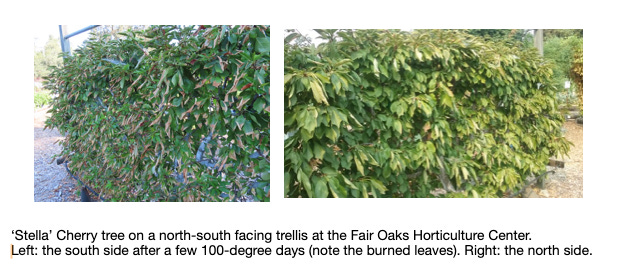
Catherine Barkett: That’s right. And speaking of heat, another thing to think about if you’re putting in new vines is looking for vines that grow well in the heat. Mars, for example, is one that can really tolerate the heat. And so you can check online or you can check with local vintners can tell you which of their vines are heat resistant.
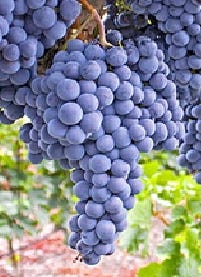
Farmer Fred: Yeah, exactly. It’s something we’re going to have to contend with. Shade cloths are a great idea. You would suspend them fairly high over the plant because you don’t want to roast the plant with a cloth that’s too close. Shade cloths come in a variety of thicknesses depending on how much shade you want. And I think maybe that’s the way we’re going, that these plants that we used to think were full sun, maybe a little bit of afternoon shade might help them in the future.
Catherine Barkett: That’s true. This actually might open up some spots in your garden where you could put grapes. And the netting that we use to keep out the critters when the clusters are ripening, that also provides a little bit of shade. So you might want to leave that on longer.
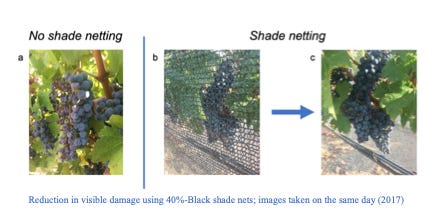
(FREDNOTE: For more information about shading grapes: Refer to the UC Publication -"The What, When, Why, and How to Use Vineyard Shade Netting”)
Farmer Fred: I notice one of the plants here, it is the Merlot. So there are still a couple of clusters of small grapes on there, but it looks like there are bags around them.
Catherine Barkett: We use organza bags on individual clusters of grapes. This is a good idea if you don’t have a lot of grapes. Maybe you just have one or two vines and the birds keep getting them. A flock of turkeys will come in and just strip that whole vine, excuse me, overnight. You take the organza bag. These are 12 by 14. You get them online and you lift them under the cluster and then tie them at the top. At home, I put two bags on because I have rather tenacious chipmunks and squirrels and things.
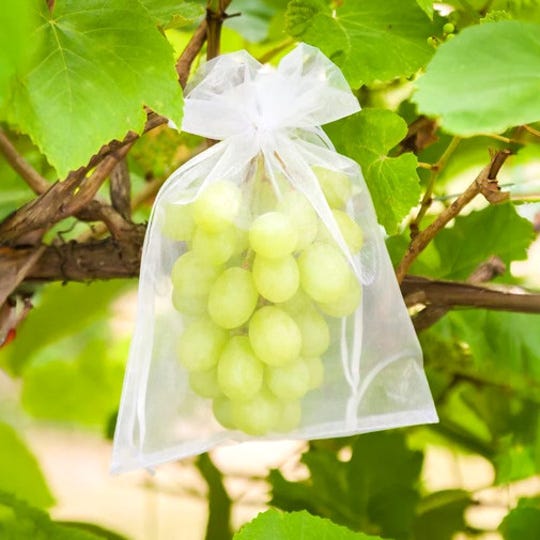
Farmer Fred: These aren’t plastic bags. This is more of a nylon mesh?
Catherine Barkett: Yes, it is. And it is reusable. I use them on my figs as well. And they get really sticky sometimes because figs will ooze the sap. And so I just throw them in the washing machine and then use them again next year. They’ll last about three years unless a rat chews right through one, which sometimes they do.
Farmer Fred: Those are pretty good sized bags, too. They’re about 12 inches by 12 inches, unlike a lot of fruit bags that you can buy online, which are maybe half that size. So it’d be easier to get a cluster of grapes inside a bag that’s 12 by 12. And again, you said the name is organza.
Catherine Barkett: Organza. Yeah, that’s the fabric. So it’s an organza bag. It’s sold at party stores. They’re used as kind of a decorative look to a present.
Farmer Fred: All right. We’ll have more information about that in the show notes. Grapes, new grapes. And old grapes, too, that are making a comeback because of their disease resistance. Catherine Barkett, Sacramento County Master Gardener and Grapehead, thank you so much.
Catherine Barkett: Thank you, Fred.
====
AFTER THE PAYWALL:
• Popular grape varieties.
• Grape varieties listed by home suitability, pruning needs, berry size.
• Spur Pruning vs Cane Pruning of grapes.
• Techniques for battling Powdery Mildew on grapes.


